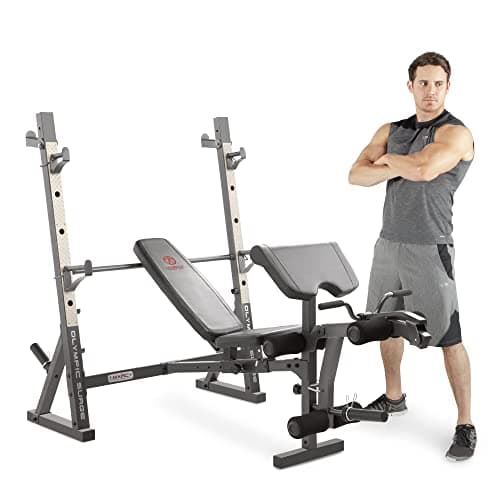
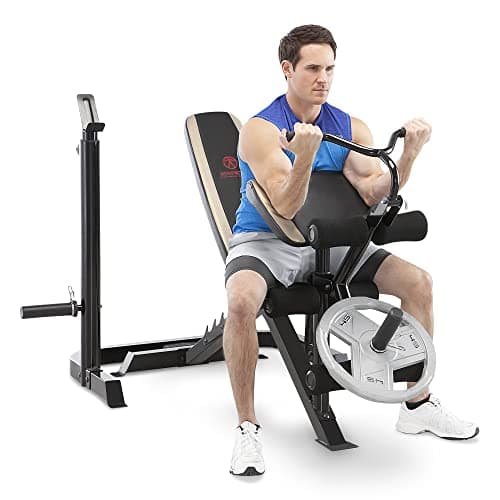
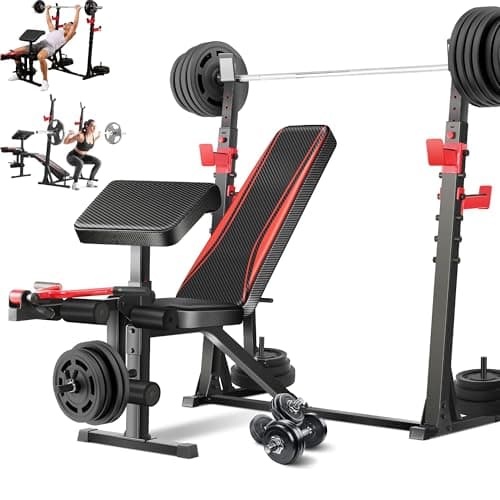
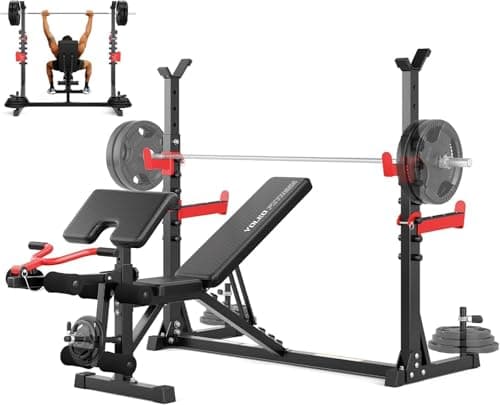
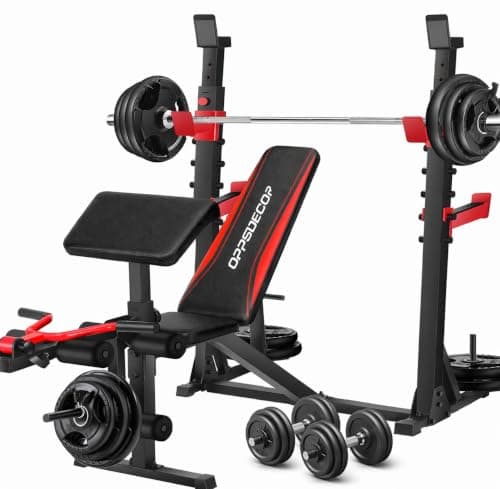
Buy the OPPSDECOR set if you want a combo: its 900 lb figure is the only one in the category that the listing says was ASTM-certified rather than simply asserted. Buy the Marcy MD-857 if you would rather have every number published, including the unflattering one — Marcy states a 300 lb bar-catch maximum, a 100 lb leg-developer maximum and a 600 lb total including the user. And read the next section before you buy either, because for a lot of people the right answer is a plain bench plus a pair of stands, not a combo at all.
What a combo actually is, and what it is not
A bench press combo is one welded or bolted frame carrying a bench pad and a pair of uprights. The uprights exist to hold a barbell at bench-press height so you can unrack and rack it lying down. That is their whole job.
What they are not is a squat rack. The uprights on a combo are short, bolted to the bench frame rather than to the floor, and rated for a bar being lifted off at chest height — not for a loaded bar on your shoulders, and not for catching a squat you failed. Several listings in this category say "squat rack" in the product title, and on the frames that let you set the catches high enough, you can indeed take a bar out and squat light. Treat that as a bonus, not as the reason to buy, and if squatting is central to your training read the squat rack rankings instead — a stand that bolts to the floor is a different class of equipment.
The honest summary of the trade: a combo gives you a bench, uprights and usually one or two accessory stations for roughly the price of a good standalone bench, in a single delivery and a single assembly. It costs you capacity, floor space and the ability to replace one piece without replacing the frame.
What we rank on
- How the capacity claim was arrived at. This is the entire ranking. A figure tested against a published ASTM standard beats a figure broken out per station, which beats a large round number with nothing behind it. The same test applies across the site — see weight bench capacity explained.
- Whether the bar-catch rating is published separately. The frame as a whole and the uprights are two different numbers, and the uprights are always the smaller one. Exactly one listing here breaks it out.
- Parts and pads. A combo is a mechanism-heavy product: adjustment ladders, seat tracks, roller pads, pins. The failure is almost never the tube — it is a pad splitting or a roller sleeve wearing. A model number that has been in a catalog for years is worth more than a higher spec from a listing that will be gone next year.
- Bench adjustability. Flat only, or flat / incline / decline, and how many positions. A combo that only presses flat is a flat bench with posts.
- Footprint. These frames are long. The Marcy MD-857 is 80 in deep by 47 in wide assembled — longer than a bench and a pair of stands together, and it does not come apart to store.
The five, side by side
| Pick | Capacity as published | How the number was arrived at | Bench positions | Extra stations |
|---|
| OPPSDECOR bench set | 900 lb | ASTM-certified per the listing | Flat / incline / decline | Leg extension, preacher curl |
| Marcy MD-857 | 300 lb bar catch; 100 lb leg developer; 600 lb total incl. user | Published per station by the manufacturer | 4-position back, 5-position seat track | Leg developer |
| Marcy MD-879 | Not published per station | Stated | Adjustable back pad | Leg developer, integrated uprights |
| Aceshin Olympic bench | 900 lb | Stated by the manufacturer | Flat / incline / decline | Leg extension, preacher curl |
| Yoleo bench with rack | 1,980 lb | Stated, no test or standard named | Flat / incline / decline | Leg extension, preacher curl, 47.44 in grip span |
Every figure above is quoted from the manufacturer listing or spec page read on 2026-10-04 and linked in Sources. Where a listing does not break a number out, the table says so rather than filling the cell with a guess.
The 300 lb number, and why it is the most useful spec on this page
Marcy publishes a 300 lb maximum on the MD-857 bar catches. That is a small number next to the 900 lb and 1,980 lb figures elsewhere on the page, and it is almost certainly the most honest one here — because it describes the uprights specifically rather than the frame as a whole.
Think about where a combo carries load. Lying on the pad, your bodyweight and the bar go through the bench frame and into four feet — a short, well-triangulated load path that can genuinely carry a lot. Racking the bar puts that same load at the top of two thin posts bolted to the end of the frame, as a bending moment. Those are different structures with different limits, and a single headline number for the product hides the smaller of the two.
So when the Yoleo publishes 1,980 lb and names no test, the number is not a lie so much as it is meaningless: nothing on that frame is being asked to hold 1,980 lb, and the listing does not say what was. The OPPSDECOR 900 lb figure is better because the listing attributes it to an ASTM certification, which means a third party tested the bench against a published standard — the same distinction we draw on the heavy-duty bench rankings.
Practically: if you bench 225 lb, every frame here is inside its own rating with margin. If you bench over 300 lb, you have outgrown the whole category and should be looking at a bench and a rack as two separate pieces of equipment.
When a combo is the right buy
There are three cases where a combo beats separate pieces, and they are all real.
One delivery, one assembly, one decision. A bench, a pair of stands and the hardware to anchor them is three purchases, three boxes and three sets of instructions. If the barrier to owning a home gym at all is the project-management of it, a single frame that arrives complete is worth something that does not show up on a spec sheet.
A fixed, modest budget. At the money these frames cost you are getting a press station plus two accessory stations. Buying the same functions separately — bench, stands, a leg-extension machine — costs multiples of it. If the alternative is a flat bench and nothing else, the combo is more gym.
Accessory work you will actually do. A leg developer and a preacher curl pad are genuinely hard to replicate with free weights alone, and the curl pad has its own ranking on the preacher curl bench page. Whether they earn their four extra mechanisms is a personal question, and we argue both sides in the best benches with leg extension.
When separate pieces win
If you squat, buy separately. A combo cannot give you a squat you can bail safely, and the cheapest honest fix is a flat bench plus a stand with spotter arms — the pairing we recommend in the best flat benches and the best squat stands. It also fails differently, and better: when a bench pad splits after eight years you replace a bench, not a bench-and-rack.
If you expect to progress past a 300 lb bench press, buy separately for the same reason. And if your floor space is irregular — a corner, a shared garage bay — two smaller objects fit rooms that one 80 in frame does not. If the room is short overhead as well as tight on the floor, the frames with a published height under 7 ft are in the best power racks for low ceilings. The lifespan arithmetic behind all of this is in how long weight benches last.
What fails on a combo frame
In rough order. The pad goes first — vinyl splits at the seam where you sit, usually somewhere between three and ten years depending on sweat, sunlight and how often it gets wiped down. Then the roller sleeves on the leg developer, which are foam over a steel tube and are the one part that is genuinely consumable. Then play at the adjustment points: a pin-and-ladder back pad that rattles is bushings and holes wearing oval, and it is the thing that makes an old combo feel cheap even when the frame is sound. The tube itself, on any of these, will outlive all three.
Which is exactly why parts availability sits so high in the ranking. Marcy's advantage over every marketplace brand here is not steel — it is that a model number which has been in the catalog for years has pads and rollers you can still order. The general version of this argument is in home gym replacement parts.
What to put with it
A combo frame needs a bar and plates, and the bar matters more than people expect: a 7 ft Olympic bar is 86 in long, and on a frame with a narrow upright span it may not sit cleanly in the catches. The Yoleo publishes a 47.44 in grip span for this reason. Bars are ranked in the barbell rankings, and the plates question — cast iron for a bench-press-centered gym, bumpers only if you will drop them — is settled in bumper vs iron plates. Rubber under the frame keeps the feet from marking a floor and takes the ring out of a racked bar; the flooring guide covers it.
If you are here because you have a bench and no rack, the wider question — what actually catches the bar on the rep you do not finish, and which workarounds are safe — is answered on can you bench press without a rack.
How to choose
Read the capacity claim before the capacity number
Look for the words that say where the figure came from: ASTM-certified, tested to, or nothing at all. A 900 lb certified figure tells you more than a 1,980 lb bare one. If a listing gives a single number for a product with two load paths, assume the uprights are the smaller limit.
Write down your bench press, then add 50 lb
If that total is under 300 lb, the whole category is open to you. If it is over, buy a bench and a rack separately — you are at the edge of what combo uprights are built for, and the frames that claim otherwise are the ones that publish the least.
Count the mechanisms you will use
Every station is a mechanism, and every mechanism is a thing to develop play. If you will never use a preacher curl pad, a frame without one is a better bench. This is the single most common regret in the category — and if the preacher pad is the station you actually want, the dedicated frames are ranked on the preacher curl bench page.
Measure 80 inches on your floor
That is roughly how long these frames are, and unlike a bench they do not fold or stand on end. Mark it out with tape and walk around it before you order.
Check that the pad and rollers are orderable
Search the model number plus "replacement pad" before you buy. If nothing comes back, you are buying a frame with a consumable you cannot replace, and the bench's real lifespan is the pad's lifespan.