If you want a leg developer, buy the one whose maker has been selling the same model long enough that pads and roller sleeves are findable. On a plain bench, brand persistence is a nice-to-have. On a bench with rollers, pivots and a load pin, it is the specification — because those are the parts that will need replacing, and a bench with an unobtainable roller is a bench with a station that no longer works.
What a leg developer actually is
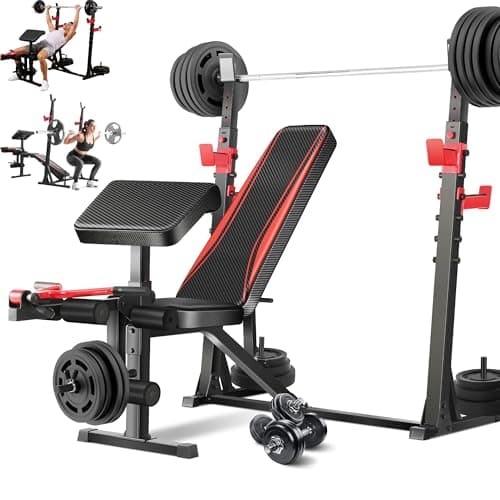
A leg developer is an arm bolted to the front of the bench with two sets of padded rollers — one above your shins for leg extensions, one behind your ankles for seated leg curls — and a peg to load plates onto. Some are fixed to the frame; some detach.
It exists because leg extensions and leg curls are hard to do with free weights alone. A barbell cannot isolate a quadriceps, and there is no natural dumbbell version of a leg curl. If your program wants those movements, this is the cheapest equipment that provides them by a wide margin — the alternative is a dedicated machine costing several times as much.
The honest case against buying one
This site's general position is that every mechanism is a liability, and a leg developer is four mechanisms: two roller pivots, a load peg, an adjustment pin and — usually — a bracket that attaches the whole assembly to the bench.
Roller pads split. They are foam over a tube with a vinyl skin, they take direct pressure from a shin bone, and they are the shortest-lived item on the bench by some distance. Adjustment pins wear their holes oval. And the attachment bracket concentrates a lever load on a part of the bench frame that a plain bench does not have to carry at all.
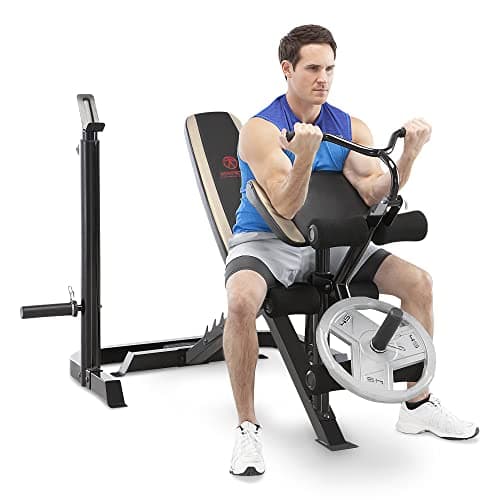
So the honest test is simple: will you use the leg developer weekly? If the answer is no — if it is a feature you like the idea of — buy a plain adjustable bench instead. It will be stiffer, cheaper, and it will still be working in fifteen years. The reasoning behind that instinct is set out in home gym equipment that lasts, and it applies just as hard to the other bolt-on station in this category — we apply the same test to curl pads on the preacher curl bench page.
What we rank on
- Parts availability. The first criterion, not the last. A long-lived model number means roller pads, pins and bolts can be sourced — see home gym replacement parts.
- Published capacity. As on any bench, a stated figure means the frame was specified rather than assumed. An ASTM-certified figure is worth more than a larger claimed one, which is the argument in weight bench capacity explained.
- Frame rigidity where the developer bolts on. The lever arm from the roller to the frame is long, and a light bench flexes there under a heavy extension.
- Whether the uprights are real. Many of these benches include squat/bench uprights. They are convenient and they are not a rack. Nothing about them replaces adjustable safeties.
- Pad quality on the bench itself. You will spend far more time pressing on it than extending your legs on it.
The uprights question, stated plainly
Most leg-developer benches also carry bar uprights, and this is where people get into trouble. Those uprights hold a bar at a fixed height. They are short, they are attached to the bench rather than to the floor, and — critically — they have no adjustable safeties.
That means a failed bench press has nothing to land on except you. It is the exact scenario the power rack exists to prevent, and it is why we treat bench-mounted uprights as a convenience for loading the bar rather than as a rack. If you press alone and near your limit, you want a rack with safeties or straps, and then a plain bench that fits inside it. The frames where those uprights are the point of the purchase — and the capacity numbers they publish — are ranked in the best bench press and squat rack combos.
How to buy one without regretting it
Check that the roller pads are replaceable before you buy
Search the model number plus "replacement pad" and see whether anything comes back. Pads are the consumable here and the entire station depends on them. A five-minute search before purchase beats a dead station in year four.
Look at where the developer attaches
A developer bolted through the main frame tube is far better than one clamped to a leg. The load is a lever, and the further the attachment is from a structural member, the more the frame flexes.
Check the plate peg diameter
Some load pegs take 1-inch standard plates, some take 2-inch Olympic. If it is the wrong one for your plates, the station is useless from day one — the distinction is covered in Olympic vs standard plates.
Measure the length
A bench with a leg developer is substantially longer than a plain bench, because the arm sticks out in front. Measure the room, and measure whether it will still fit inside a rack if you own one.
Prefer detachable if you are unsure
A developer that unbolts lets you run the bench plain when you are not using the station, which keeps the footprint down and takes the load off the attachment point.
What wears out, and when
Roller pads, first and by a long way. Foam compresses and vinyl splits where a shin bone presses into it every rep. Expect these to be the first thing you replace.
The pivot bushings, second. Usually plastic, usually unlubricated from the factory. A little grease at assembly meaningfully extends them.
The adjustment pin and its holes, third. Repeated loading ovals the hole, and an ovalled hole means a pin that rattles.
The bench pad itself, eventually — the same story as on any bench, and one of the genuinely satisfying home repairs. The method is in replacement parts.
What does not wear is the frame. As with everything on this site, the steel outlives the parts bolted to it — which is why the parts question is the buying question.