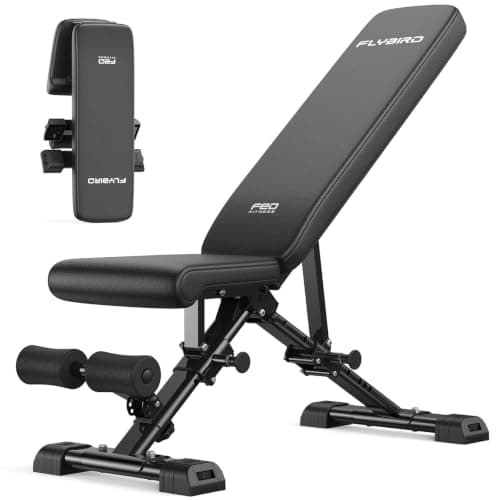
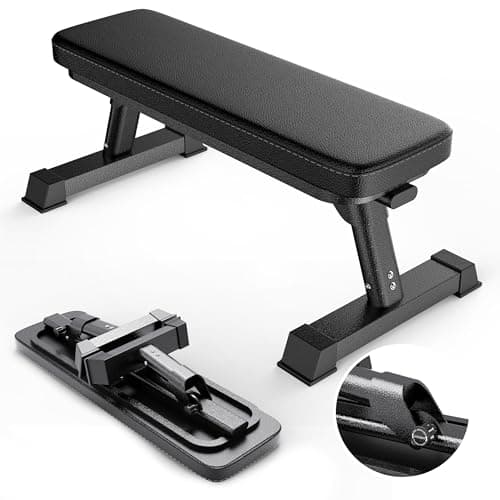
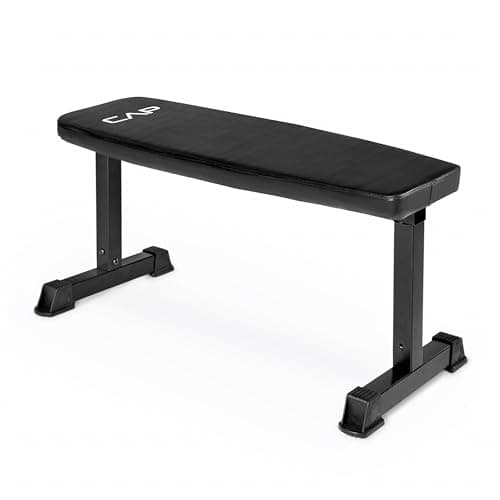
Yes, if you intend to press a barbell, press dumbbells at any angle, or do supported rows — a bench is the cheapest purchase in a home gym that changes which exercises exist for you, and a welded flat bench costs less than a pair of plates. No, if you have not yet bought a rack with safeties or a barbell worth owning, because a bench bought before those two is a bench you cannot use safely. Our starting pick is the plain welded flat bench: no hinge, no ladder, nothing to fail, and it covers flat pressing, rows and step-ups permanently. Step up to the FLYBIRD WB5 if you want incline and decline too — ASTM-certified to 800 lb, with a 30 inch backrest. Take the Finer Form foldable flat bench if the room has another use and you want the storage without the extra mechanisms, at a published 1,000 lb.
What a bench actually adds
It is worth being precise, because "you need a bench" is said far more often than it is explained. A bench does exactly three things:
- It puts your torso at a chosen angle and holds it there. That is the whole mechanism. Flat, inclined, declined or near-vertical, the bench decides the angle so your muscles do not have to.
- It gets your back off the floor so your arms can travel past it. A floor press stops when your elbows hit the ground. A bench press does not, and that extra range is the main reason a bench exists.
- It gives you something to brace against. A supported row, a seated press, a chest-supported movement — all of them need a surface to push into, and your body is a worse one than a pad.
Everything else attributed to a bench is a side effect of those three. And notably, none of them has anything to do with capacity, adjustability or brand — which is why the entry-tier answer on our bench budget page is a genuinely good answer and not a compromise.
What you can train with no bench at all
More than people assume, and this is the honest part of the page. Without a bench you still have:
- Every squat and every deadlift variation — neither has ever needed a bench, and between them they cover most of the body.
- Standing presses, including the overhead press, which is the single best pressing movement that requires no bench at all.
- Floor presses with a barbell or dumbbells. Shorter range than a bench press, and a useful lift in its own right rather than a substitute.
- Pull-ups, rows from the floor or a rack, carries, and every accessory movement done standing.
If your equipment today is a rack, a bar and plates, you have a complete strength program without a bench. What you do not have is incline work, decline work, seated pressing, or a full range bench press — and if none of those is in your plan, you can wait.
The three cases where the answer is no
You have not bought safeties yet
This is the important one. A bench press with no spotter and no safeties is the most dangerous thing that happens in a home gym, because a failed rep traps the bar on your chest. A bench bought before a rack with safeties or a pair of straps buys you the ability to do that, which is not an upgrade. Buy the safeties first; the options are compared on safety bars vs safety straps, and the no-rack version of the problem is worked through on can you bench press without a rack.
Your bar is the weak link
If the choice is between a bench and a barbell you can trust, the bar wins every time. A bench is a passive steel frame; a bar is the component under load in your hands. We make this argument at length in building a home gym on a budget and we have never had reason to soften it.
Your program is squats, deadlifts and carries
Some people train entirely with the barbell on the floor or on their back. If that is you, a bench is an object that takes up floor space, and the honest answer is to skip it until the program changes. Buying equipment for a program you do not follow is the most common way a home gym gets expensive — the subject of what equipment you actually need for strength training.
Flat or adjustable, if the answer is yes
Two thirds of the benches sold are adjustable and a good share of them get used flat. The trade is simple enough to state in a sentence: an adjustable bench buys you angles and costs you mechanisms, and a flat bench has no mechanisms at all.
| As published | CAP flat | FLYBIRD WB5 | Finer Form foldable flat |
|---|
| Angles | Flat only | Incline / flat / decline | Flat only |
| Rated capacity | Not published | 800 lb, ASTM | 1,000 lb |
| Moving parts | None | Fold hinge, back + seat ladder | One fold hinge |
| Folds for storage | No | Yes, flat | Yes |
| Backrest | Not published | 30 in | Not published |
| Pad | Basic | Not published | Not published |
| Can go inside a rack | Yes, compact | Yes | Yes |
Every cell is quoted from the manufacturer listing linked in Sources, and where a listing does not state a figure the cell says so. If your program has incline pressing in it, buy the adjustable once rather than buying a flat bench and then an adjustable — the full comparison is on flat vs adjustable bench, and the dumbbell-specific version is on the best benches for dumbbells.
When to buy it, in a staged build
The order we recommend across the site puts the bench fourth: a rack with safeties, then a barbell, then plates, then a bench. That is not because a bench is unimportant — it is because the first three are what make the bench usable, and because a bench is cheap enough to add the moment the first three exist.
The one adjustment to that order: if you are training with dumbbells and no barbell, the bench moves to second, right after the dumbbells. With no bar there is nothing to rack and no safeties to buy, and the bench is immediately the thing that doubles your exercise list.