The picks below run cheapest first, so the numbers beside them are tiers rather than a ranking. The short version: the entry tier buys a welded flat bench with nothing to break, the next buys a tested capacity and an adjustable back, the middle buys full incline-to-decline travel and a long pad, and the top buys bracing and headroom you will probably never use. If you want the best adjustable bench regardless of price, that is the adjustable bench roundup. This page answers the question that one does not: what am I giving up by spending less, and what am I actually getting by spending more?
Benches break the usual rule about cheap equipment
On almost every other page of this site, the cheapest option is a compromise you accept knowingly. Benches are different, and the reason is mechanical. A plain welded flat bench has no hinge, no ladder, no pivot and no adjustment pin — so it has nothing that can develop play, and it is close to a permanent object. Every step up the price ladder adds a mechanism in exchange for a capability.
That means the honest question is not "how much should I spend" but "which capabilities do I need, given that each one costs me a moving part". The same logic runs through flat vs adjustable bench, and this page is the money version of it.
Entry tier — a welded flat bench, and nothing to go wrong
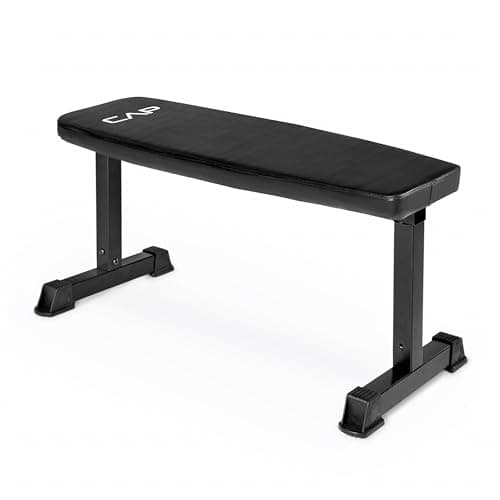
At the bottom of the market you get a flat utility bench on a welded steel frame. The CAP flat bench here is the example: compact, no adjustment, and comfortable enough for flat pressing, rows, step-ups and as a box. What you do not get is any angle at all.
What you also do not get is a part that fails. On a site built around equipment that outlives you, that is a genuine argument and not a consolation prize — the frame does not know what it cost, and there is no pad hinge to loosen in year six. If your program is flat pressing and accessory work, this tier is not a compromise.
Lower tier — a tested capacity and a back that moves
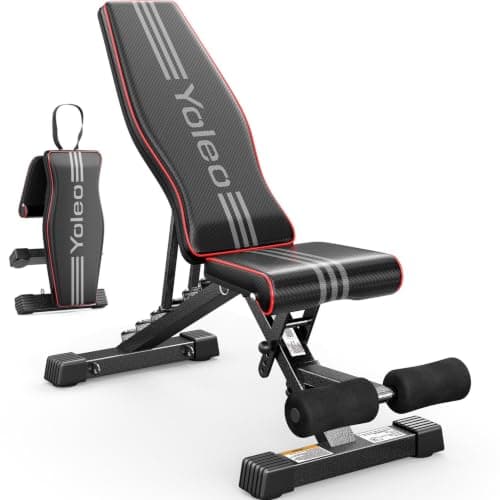
The first real step up buys two things at once: an adjustable back pad, and in the best case a capacity figure that was tested rather than asserted. The YOLEO here states an ASTM-certified 827 lb and that the bench arrives 98% pre-assembled, which are both unusual at this end of the market.
The cost is the folding frame. A hinge is the one mechanism on a bench that reliably develops play over years of use, and the benches in this tier all have one. If the bench will live permanently under a rack and never fold, a fixed frame of the same money is stiffer — which is the trade spelled out on the folding bench page.
Mid tier — full travel and a long pad
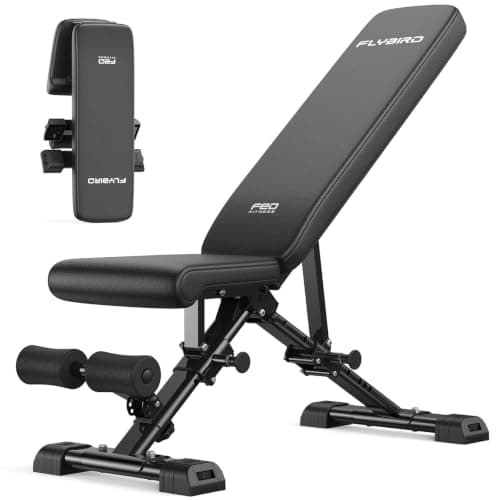
Around the middle of the range the specification jumps rather than creeps. The FLYBIRD WB5 sits here: an ASTM-certified 800 lb rating, a full incline-to-decline range rather than incline only, a 30 inch backrest, and it still folds flat. This is the best-value band in the whole category and it is where most home gyms should be shopping.
The 30 inch backrest is the quiet upgrade in this tier and the one worth understanding. A short pad leaves your head unsupported at a steep incline and your hips unsupported when flat; a long one supports the whole torso through the range. It is a comfort spec that reads as trivial and turns out to be the thing you notice every session.
Upper-mid tier — the gap closes and the seat starts adjusting
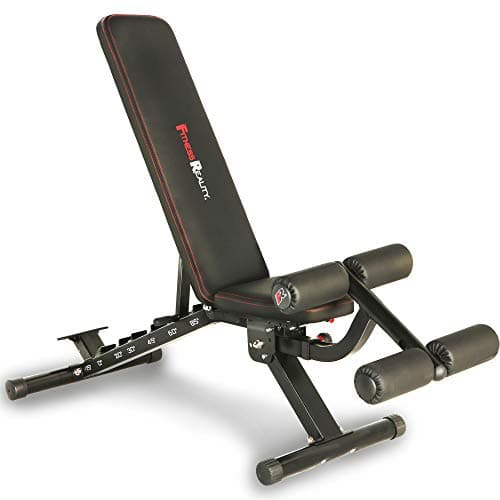
The next step buys refinement rather than capability. The Fitness Reality 2000 Super Max XL publishes an 850 lb capacity, a no-gap seat-to-back design and an adjustable seat — which together fix the exact complaint that cheaper adjustable benches generate, a wedge of air between the seat and the backrest at steep incline that you sit into.
That is a real improvement for anyone who presses at an incline or presses overhead seated, and it is worth the step. What it is not is more bench: the capacity is barely different, the angles cover the same range, and the frame is bulkier and heavier to fold. Whether the gap is worth paying to remove is the subject of the gap page.
Top tier — headroom, and the point where money stops working
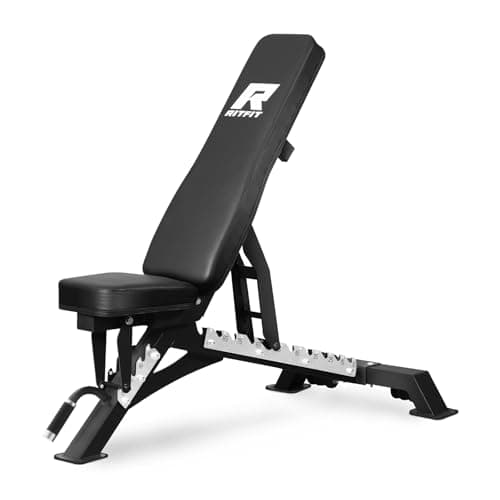
At the top of what a home bench sensibly costs you buy rated headroom and a leg lock. The RitFit bench publishes 1,300 lb — the highest figure of any bench we rank — with full FID adjustment and a leg lock for secured decline work.
Here is the honest note this page exists for: that rating is a static manufacturer figure, not a tested certification, and almost nobody training at home will approach even the 800 lb number three tiers down. If you press very heavy and want margin, or you want the leg lock, this tier is a sensible purchase. If you are buying it because 1,300 is a bigger number than 800, you are buying marketing. The whole argument is in weight bench capacity explained.
The five tiers, side by side
| As published | CAP flat | YOLEO | FLYBIRD WB5 | Fitness Reality 2000 | RitFit |
|---|
| Tier | Entry | Lower | Mid | Upper-mid | Top |
| Rated capacity | Not published | 827 lb, ASTM | 800 lb, ASTM | 850 lb | 1,300 lb |
| Claim tested to a standard | n/a | Yes, ASTM | Yes, ASTM | No standard named | No standard named |
| Angles | Flat only | Adjustable back | Incline / flat / decline | Incline / flat / decline | Incline / flat / decline |
| Moving parts | None | Fold hinge, back ladder | Fold hinge, back + seat ladder | Fold hinge, back + seat | Back + seat, leg lock |
| Seat-to-back gap | No gap possible | Not published | Narrow gap at steep incline | No-gap design | Not published |
| Folds | No | Yes | Yes, flat | Yes | Not published |
| Leg lock | No | Not published | Not published | Not published | Yes |
| Assembly | Minimal | 98% pre-assembled | Not published | Not published | Not published |
Every cell is quoted from the manufacturer listing linked in Sources, and where a listing does not state a figure the cell says so. Read the third row before the second: two of these five say their capacity was certified to a published standard and three do not, and that distinction is worth more than the gap between 800 and 1,300.
Where the money is genuinely better spent elsewhere
A bench is one of the cheapest things in a home gym and one of the least likely to limit you. If your budget is fixed and you are deciding between a better bench and something else, the something else usually wins:
- Safeties, if you bench alone. No bench makes a failed press survivable. A rack with safeties, or a pair of straps, does — and that is a larger safety improvement than any amount of bench. See safety bars vs safety straps.
- The bar, always. A cheap bar is the one component on this site we tell people never to buy, and the money saved on a bench is well spent there. The reasoning is in building a home gym on a budget.
- Flooring, if the bench sits on concrete. Feet mark floors and floors mark feet. Our flooring guide covers what belongs underneath.
How to pick a tier
Start from your program, not your budget
Write down the exercises you will actually do in the next three months. If none of them is at an angle, the entry tier is the correct purchase and the four tiers above it are buying you nothing. If several are, skip to the mid tier — an adjustable bench that only inclines will annoy you within a month.
Prefer a tested number to a bigger one
An ASTM-certified 800 lb means the frame was submitted for testing against a published standard. An asserted 1,300 lb means someone typed it. Both are probably strong enough for you; only one tells you something about the company.
Count the mechanisms you are buying
Every tier adds one: a fold hinge, then a back ladder, then a seat ladder, then a leg lock. Each is a capability and each is a part that can loosen. Buy the capabilities you will use and no more — that is the whole buy-it-for-life argument applied to a bench.
Check whether the pad is a part you can replace
Upholstery is what ends a bench, not steel. Before you buy at any tier, check whether the maker sells a pad or at least still answers the phone — a bench with a re-coverable pad from a company still trading is worth more than a stiffer frame from a brand that vanished. Our replacement parts guide covers how to check.
Buy the bench last
In a staged build the bench is rarely the limiting purchase, which means it is the right place to economize early and upgrade later if you find a reason to. A flat bench bought at the entry tier does not become worthless when you add an adjustable — it becomes the box, the step and the row bench.