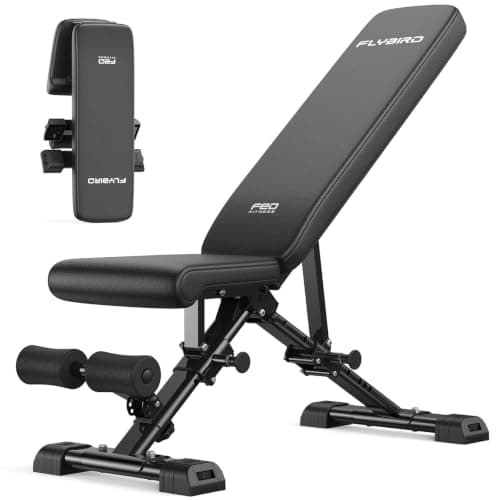
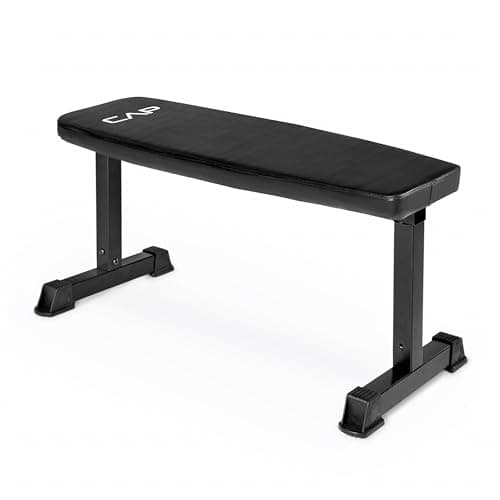
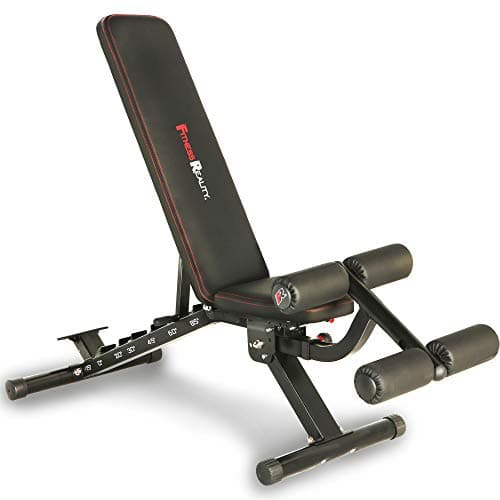
The gap exists because the seat and the backrest are two separate pads that pivot on independent frames — the moment the backrest rises, the top of the seat and the bottom of the backrest swing apart, and the wedge of air between them is the gap. It matters on exactly two movements: a steep seated press, where your tailbone sits into it, and a heavy incline press, where it stops you driving your hips into the bench. On flat pressing it does not exist, and on an incline under about 30 degrees it is irrelevant. The bench to buy if it bothers you is the Fitness Reality 2000 Super Max XL, whose listing states a no-gap design at a published 850 lb. The FLYBIRD WB5 is the value answer, with a narrower gap at steep incline than typical and an ASTM-certified 800 lb. And a flat bench — the CAP here — cannot have a gap at all, because it has one pad and no pivot.
Where the gap comes from
An adjustable bench has to do two incompatible things. It has to fold or flatten into a single straight pressing surface, and it has to hinge into an L shape with the backrest up. The only way to do both with two pads is to mount them on frames that move independently — and independent frames pivot around different centers.
Picture the backrest rotating up around its hinge at the bottom. The bottom edge of that pad travels backwards and upwards as it goes. The seat stays where it is. The distance between them grows with the angle, which is why the gap is invisible at flat, small at a shallow incline and at its widest at the steepest setting — the exact position where you are most likely to be sitting on it.
This is a geometry problem, not a quality problem, and that distinction matters when you are shopping. A more expensive bench does not automatically have a smaller gap. What a better bench has is a seat that slides forward as the back rises, or a longer backrest pad whose bottom edge overlaps the seat through the range — both are design choices, both cost money, and only some listings mention them.
When it actually matters
Honest answer: less often than the complaints suggest, but not never. Two cases are real.
- Seated pressing at a steep angle. This is the one. At 75 to 90 degrees your weight is going straight down through your tailbone, and if the gap is under it you will feel it on every set. Anyone buying a bench mainly for seated dumbbell shoulder pressing should treat this as a real spec.
- Heavy incline pressing with leg drive. On an incline press you want to drive your hips and upper back into the bench as one solid line. A gap at the hinge breaks that line and some of the drive goes into the air instead of the pad.
And the cases where it genuinely does not matter: flat pressing of any kind, because at flat the pads are in line and the gap closes. Rows, where you are face down or braced. Shallow inclines under about 30 degrees. Every dumbbell accessory movement done lying flat. If that list describes your training, the gap is not a reason to spend more — and our bench budget page sets out what the money buys instead.
Why a gap filler pad is usually the wrong fix
Search the gap and you will be offered a wedge pad to drop into it. We would not, for three reasons, and none of them is snobbery:
- It only fits one angle. The gap changes size through the range. A wedge sized for the steepest setting is loose at every other, and a loose pad under your tailbone while you press overhead is worse than no pad.
- It is unsecured. Nothing holds it in position but friction and your bodyweight. Under lateral load — and a seated dumbbell press is a lateral load — it moves.
- It hides the mechanism. The hinge, the ladder and the adjustment pin are the parts you should be able to see and check. Covering them with foam means you stop looking at the part that actually wears, which is the opposite of how we treat equipment on this site — see how long weight benches last.
The two fixes that do work: buy a bench whose geometry avoids the gap, or set the backrest one notch shallower than you were going to and brace harder. The second one is free and solves more complaints than people expect.
The three, side by side
| As published | Fitness Reality 2000 | FLYBIRD WB5 | CAP flat |
|---|
| Seat-to-back gap | No-gap design stated | Narrow gap at steep incline | No gap possible — one pad |
| Rated capacity | 850 lb | 800 lb, ASTM | Not published |
| Angles | Incline / flat / decline | Incline / flat / decline | Flat only |
| Seat adjusts separately | Yes | Not published | No seat |
| Backrest | Not published | 30 in | Not published |
| Folds | Yes | Yes, flat | No |
| Moving parts | Fold hinge, back + seat | Fold hinge, back + seat ladder | None |
Every cell is quoted from the manufacturer listing linked in Sources, and where a listing does not state a figure the cell says so. Note how little this category publishes about the gap: of every bench we rank, one states a no-gap design outright, one is specific that its gap is narrower at steep incline, and the rest say nothing at all. If the gap matters to you, treat silence as a gap.
The spec to ask for instead
Because listings so rarely publish gap dimensions, the useful proxy is whether the seat adjusts independently of the backrest. A bench with a separately adjustable seat can be set to close the gap at the angle you actually use; a bench with a fixed seat cannot, whatever its gap measures at the factory.
That is the specification worth filtering on, and it has a second benefit: an adjustable seat is also what stops you sliding down a steep bench, which is the complaint that usually arrives one week after the gap complaint. Both are solved by the same part. The benches that have it are ranked on the adjustable bench roundup and, for dumbbell work specifically, on the best benches for dumbbells.
What the gap tells you about the bench
One last use for all this. The gap is a window onto how the bench was designed, and it is a reasonable proxy for whether anyone thought about the thing as a pressing platform or merely as a folding frame with pads on it. A maker who publishes a no-gap design, or who tells you the gap narrows at the steep settings, has looked at the problem. A listing that shows only photographs of the bench at flat has not.
Apply the same reading to the rest of the spec sheet. Benches that publish a certified capacity rather than an asserted one, a backrest length, or a pad thickness are telling you they measured something — the argument we make about every number in this category on weight bench capacity explained.