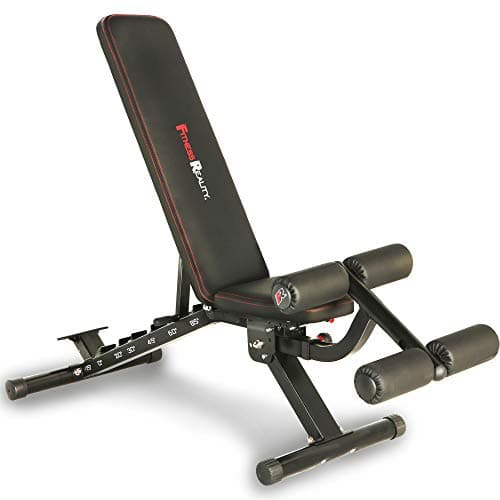
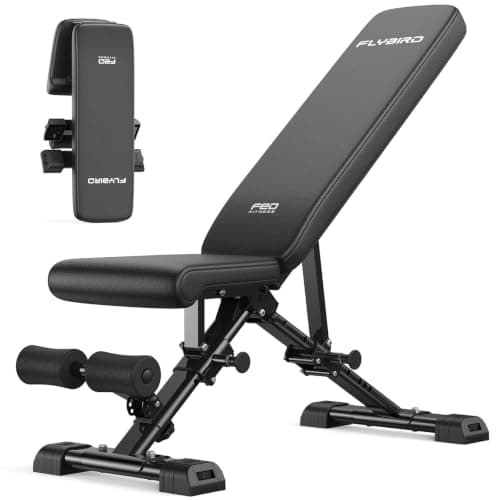
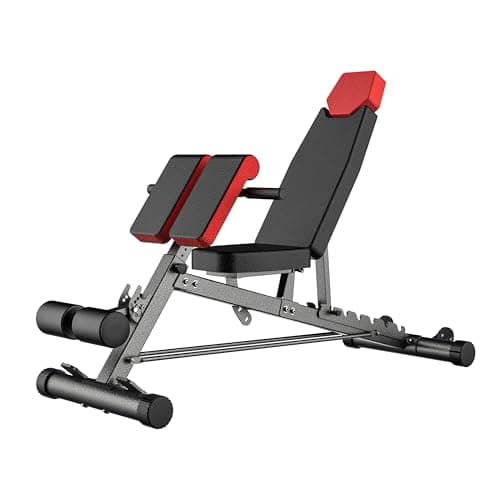
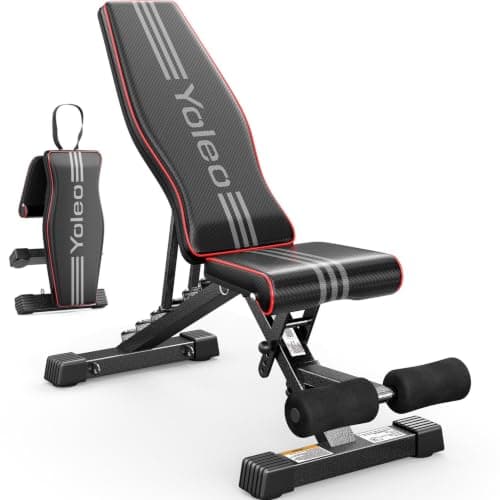
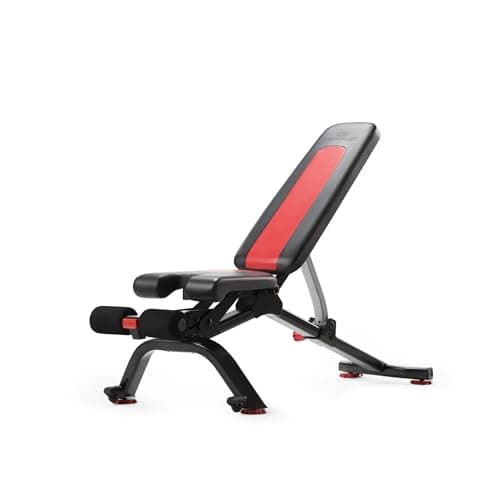
Buy the BowFlex 5.1S if you train with dumbbells: the pad is the widest and most comfortable here, it runs through six back positions including the steep ones a seated shoulder press needs, and it stands upright and rolls away on wheels when you are finished. Buy the Fitness Reality 2000 Super Max XL if you want the most positions and no seat-to-back gap — it is rated 850 lb and its no-gap design fixes the one complaint every cheap adjustable bench generates. Buy the FLYBIRD WB5 if value decides it: ASTM-certified to 800 lb, a 30 inch backrest, full incline to decline, and it folds flat. Buy the Finer Form FID if you want the bench to double as a back-extension and Roman chair. And buy the YOLEO if you want a certified capacity for the least money and would rather not spend an evening assembling it — that listing states 98% pre-assembled and an ASTM-certified 827 lb.
If you want these benches ranked as general-purpose pressing platforms rather than as dumbbell benches, that is the adjustable bench roundup. This page ranks on the three things dumbbell work specifically asks for, and they are not the things a barbell bench is judged on.
Dumbbells ask a bench for three things a barbell does not
Barbell benching is a narrow job: the bench has to be the right height, sit still, and not flex while a loaded bar travels in a straight line above it. Everything else is comfort. Dumbbell training is the opposite — the load is in your hands, the path is yours to choose, and the bench has to accommodate the movement rather than merely support it.
- A back that goes near-vertical. The seated dumbbell shoulder press is the single most common reason a dumbbell trainee buys a bench, and it wants a back angle up around 80 to 90 degrees. A bench whose steepest setting is a 45 degree incline cannot do it. Count the published positions and look at where the top one stops.
- A pad your shoulders can work around. On a barbell press your hands are fixed. With dumbbells they travel out and down past the line of the bench, and a pad that is too wide stops your shoulder blades retracting at the bottom of the rep. This is the one spec on this page where wider is not automatically better — it is a fit question, not a quality question.
- A seat to brace against. At steep angles you slide. A bench with a seat that adjusts independently of the back, or a leg lock, keeps you planted; a single-pad bench at 80 degrees becomes a slide with a heavy dumbbell in each hand.
Rated capacity matters less here than on any other bench page on this site, and it is worth saying plainly: two 50 lb dumbbells under a 200 lb lifter is a 300 lb load on a bench whose lowest published rating is 800 lb. What the rating really tells you is how the maker thinks about the frame — which is why we still print it, and why what a bench capacity rating actually means is worth ten minutes before you order.
The five, side by side
| As published | BowFlex 5.1S | Fitness Reality 2000 | FLYBIRD WB5 | Finer Form FID | YOLEO |
|---|
| Rated capacity | Not published | 850 lb | 800 lb, ASTM | Not published | 827 lb, ASTM |
| Back positions | 6 stated | Incline / flat / decline | Incline / flat / decline | Incline / flat / decline | Adjustable back pad |
| Decline | No | Yes | Yes | Yes | Not published |
| Seat-to-back gap | Not published | No-gap design | Narrow gap at steep incline | Not published | Not published |
| Pad | Wide pad | Not published | 30 in backrest | Not published | Thinner than premium |
| Seat or leg anchor | Not published | Adjustable seat | Not published | Leg anchor | Not published |
| Stores flat or upright | Stands upright, wheels | Folds | Folds flat | No | Folds |
| Extra stations | None | None | None | Back extension, Roman chair | None |
| Assembly | Not published | Not published | Not published | Not published | 98% pre-assembled |
Every cell is quoted from the manufacturer listing linked in Sources, and where a listing does not state a figure the cell says so. The honest shape of this table is that the dumbbell-relevant specs — pad width, the exact back angles, whether the seat locks — are the ones this category publishes least. That is why the top pick is the bench whose listing is specific about the pad and the position count rather than the one with the biggest number.
You do not need a rack, and that changes the shortlist
The quiet advantage of training with dumbbells is that the bench is the whole apparatus. There are no uprights to clear, no J-hook height to match and no bar path to keep free — which means a bench that would be a poor choice inside a cage can be the right choice in the middle of a room. A bench that stands up and rolls into a closet is genuinely more useful to you than a stiffer one that lives permanently in the way.
It also means the fitment rules on benches for a power rack do not apply. If you already own a cage, read that page instead — the constraint there is footprint and how easily the bench comes back out, and it eliminates several of the picks here.
What dumbbells do need is somewhere to live. A pair of heavy adjustables on the floor beside a bench is the most common trip hazard in a home gym, and the fix is one of the cheapest purchases in this whole category — see our dumbbell storage roundup.
The folding question, answered for dumbbell users specifically
Three of these five fold and one stands upright on wheels, and on most of our bench pages we treat a fold as a mild negative: a hinge is a mechanism, and mechanisms develop play. For dumbbell training that calculation shifts, for one reason. A dumbbell bench spends most of its life at an angle other than flat, gets turned to face a wall or a mirror, and is often the only piece of equipment in the room — so it is handled far more often than a bench that lives under a rack.
A bench that is annoying to move gets left in the middle of the floor; a bench left in the middle of the floor gets resented, then unused. If storage is the binding constraint, the full ranking is on the folding bench page, and the long-run cost of the hinge is covered in how long weight benches last.
What wears out on a bench used for dumbbells
The frame is not the wear item on any bench; nobody reports a snapped bench tube. Three things age, and dumbbell training accelerates two of them:
- The pad. Upholstery compresses and vinyl splits at the seams, and a bench that is adjusted several times per session gets its pad handled more than one that stays flat. This is the part that ends most benches.
- The ladder or pin that sets the angle. Every adjustment cycles it. A bench set once a week outlives a bench set four times a session, which is the argument for buying fewer, better-engineered positions rather than the longest list.
- The feet. Rubber caps wander off and then the frame is steel on floor. They cost almost nothing and are worth checking for before you buy, which is the point of our replacement parts guide.
None of that is a reason to buy an expensive bench. It is a reason to buy one whose pad can be re-covered and whose maker will still be trading in five years — the same argument the whole site makes in home gym equipment that lasts.
How to buy a bench for dumbbell training
Find the steepest back angle before anything else
If you want to press overhead seated, the bench must go near-vertical, and most listings do not say whether they do. Count the published positions and treat a listing that describes itself only as "incline, flat and decline" as unproven for shoulder pressing. Six stated positions with a steep top setting is worth more than an unspecified range.
Treat pad width as a trade, not an upgrade
A wide pad is more comfortable to lie on and slightly worse for heavy dumbbell pressing, because it can stop your shoulder blades retracting. If you are broad through the chest and press heavy, narrower is better. If you mostly row, curl and press light, take the comfortable pad. Nobody can make this call for you from a spec sheet; the point is to know it is a trade.
Decide whether decline matters to you
Four of these five decline and the top pick does not. For dumbbell work decline is the least used of the three angles — and the one that most needs a leg lock, because you are inverted with weight in your hands. If your program has no decline work in it, do not pay for the position.
Buy the capacity you can verify, not the biggest one
Two of these five state ASTM certification, which means the number was tested against a published standard rather than asserted. On a bench that will never see more than a few hundred pounds the certification is the more meaningful signal, because it tells you the company submits its products for testing at all.
Match the bench to the dumbbells you actually own
If your dumbbells top out at 50 lb a hand, every bench here has enormous margin and you should buy on angles and pad alone. If you are at the heavy end of the heaviest adjustables, bracing becomes the issue rather than capacity — look for the independently adjustable seat, not the bigger rating.