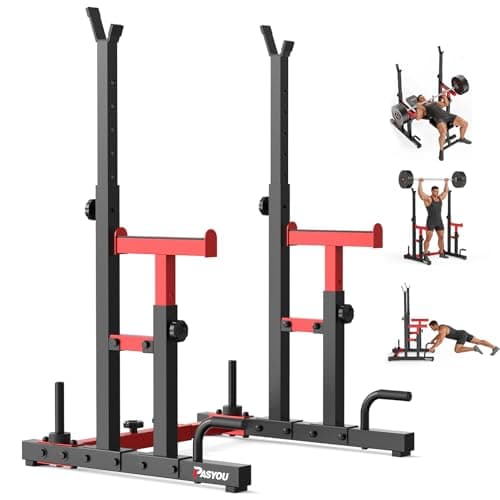
The best power cage for most home gyms is the PASYOU: a published 1,200 lb total on adjustable uprights, in a compact enclosed frame at the bottom of the market. It is for the lifter who squats and benches alone and wants four posts around them. The budget pick is the VEVOR, which publishes 1,000 lb and arrives complete — J-hooks, safeties, a pull-up handle, band pegs, plate posts and a bar hook in the box, so there is no second order.
"Power cage" and "power rack" are used interchangeably in listings and they should not be. A cage is four uprights joined top and bottom, which means the catch bars run between front and back posts and a failed rep lands on steel on both sides of you. An open rack is two uprights with catches cantilevered off them. Both are useful; only one of them lets you bail backwards. Every pick on this page is genuinely enclosed — the open frames are on the squat rack hub.
Every cage here sits at the cheaper end of the market. If your budget reaches further, the frames between these and the enthusiast tier are ranked on the best power racks under $1,000 — which is where published steel gauges and real parts catalogs start to appear.
Ceiling height decides this before anything else
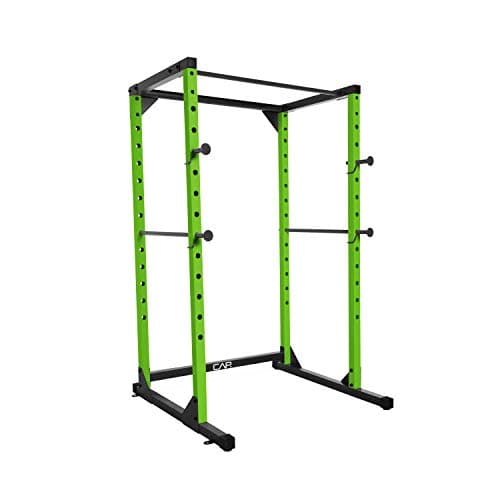
A full-height cage wants roughly 7 ft 6 in of ceiling: the frame, the pull-up bar and your head. Most listings do not say so, which is why the CAP 6-foot cage earns its place here — it publishes a 72 inch height and a 44 by 48 inch footprint, which is the rare case of a cage listing telling you whether it will fit the room. If your garage has a low ceiling or a door track in the way, start with the best power racks for low ceilings and come back.
The trade on the CAP is explicit on its own listing: a 600 lb recommended maximum and 12 and 14-gauge steel, which is lighter than the enthusiast tier. You are buying it for the 72 inches, not for the steel, and that is a perfectly good reason to buy something.
Published rating, and the gap between rating and stiffness
Three of these cages publish totals well above anything a home lifter will load: 1,200 lb, 1,000 lb and 2,000 lb. Read those as static manufacturer figures rather than tested certifications — none of these listings names a standard, and none publishes a warranty term.
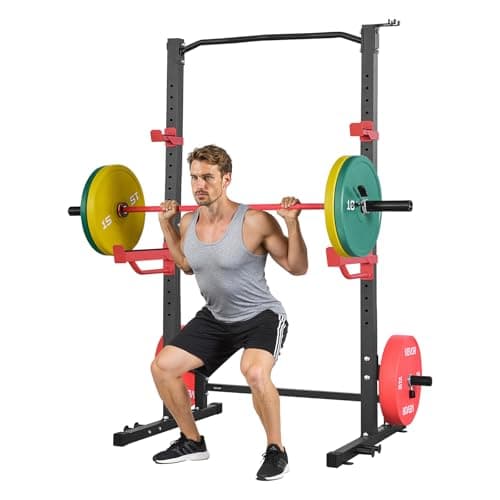
More usefully, a high rating is not the same as a stiff frame. The VEVOR publishes 1,000 lb on a frame that weighs about 60 lb, which tells you about the steel and nothing about how it behaves when you rack a heavy bar. Load the plate posts, keep it against a wall, and treat the number as a floor rather than a promise. The reason gauge and section matter more than the headline capacity is set out in the steel gauge guide and in 2×2 vs 3×3 power racks.
Upright section is the spec that decides your next ten years
The VEVOR publishes 2 × 2 inch uprights, which is the commonest profile in home cages. That is worth knowing for a reason that has nothing to do with strength: third-party J-hooks, spotter arms and dip bars made for 2 × 2 are easy to find, which makes the cage repairable and upgradeable long after the brand stops answering email. Measure hole diameter and spacing before ordering anything, because section alone does not guarantee fit — the same warning we give on the attachment roundup.
Cables in the box, or cables later
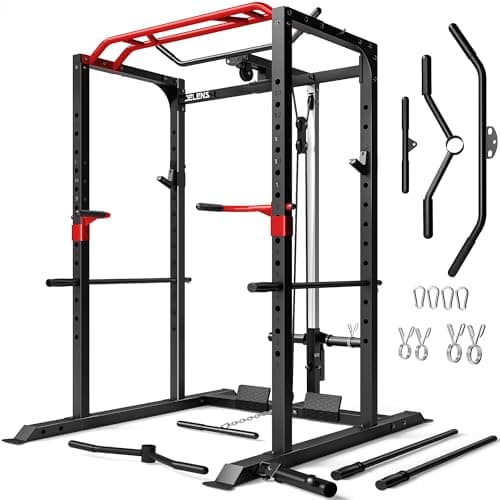
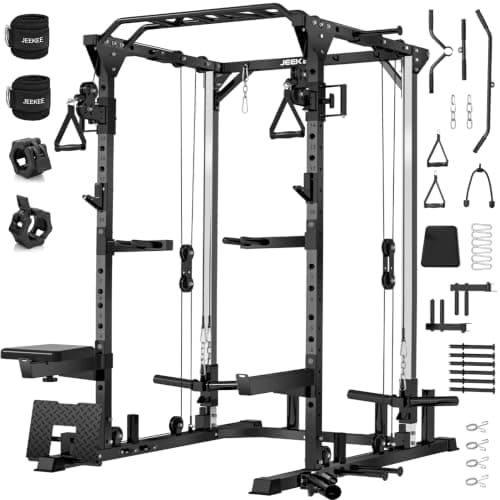
Two of these five arrive with a cable system already attached, and that changes the arithmetic. The JELENS publishes a 2,000 lb rating with a lat tower included for less than most bare cages plus a tower; the JEEKEE publishes independent dual pulleys and a seat, which is the closest thing here to a commercial functional trainer. If you want pulling and isolation work from the same frame, buying it built in is cheaper than buying it twice.
The honest cost is service life. Steel lasts; cable assemblies do not. Plan on replacing a cable eventually on either of them, and if you only barbell train, buy a cage without cables and put the difference into plates. The full comparison is on the best power racks with cables.
Who each pick is for
PASYOU — wants an enclosed cage with a high published total for the least money, and will not add cables. CAP 6-foot — has a ceiling under 7 ft and needs a listing that publishes its height and footprint. JELENS S11 — wants the lat tower in the box and the cheapest route into a cable cage. VEVOR — the budget pick: wants everything in one box and a 2 × 2 upright that third-party parts fit. JEEKEE — wants independent dual pulleys and a seat, and accepts that the cables are the part that dates.
If the footprint is the problem rather than the budget, the wall-mounted and folding frames are on the folding rack page. If a pull-up bar is the main thing you want from the frame, see the best squat racks with pull-up bars.