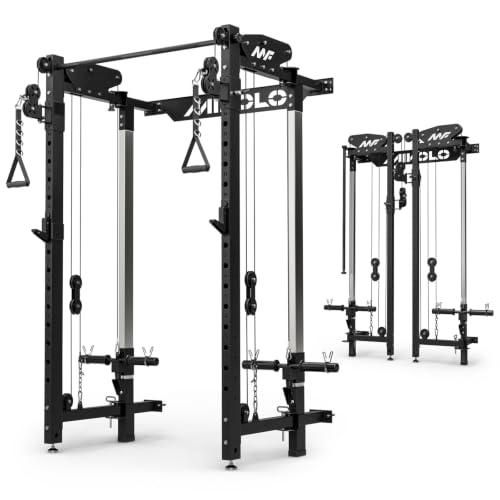
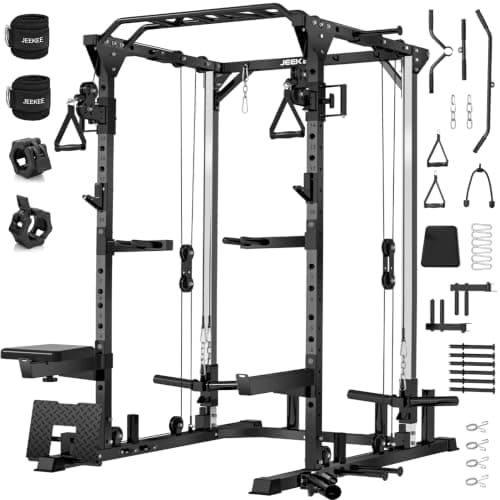
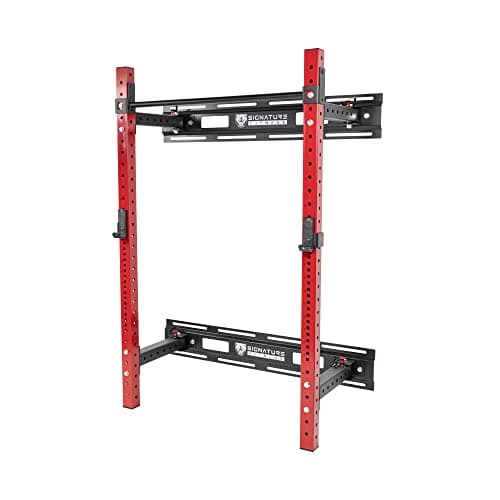
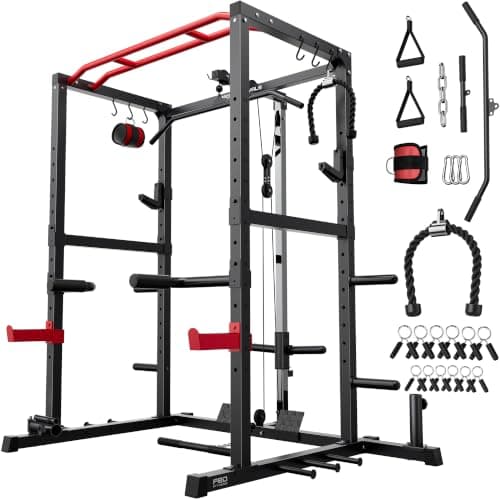
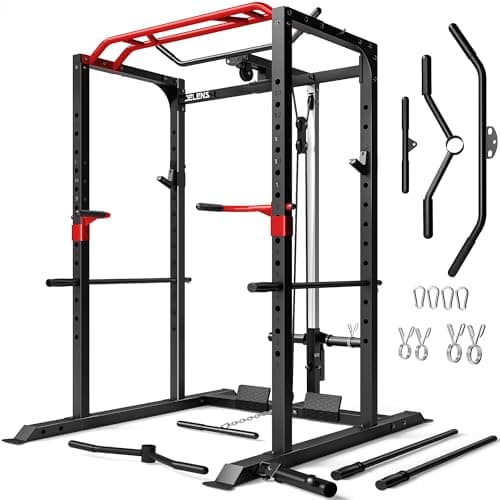
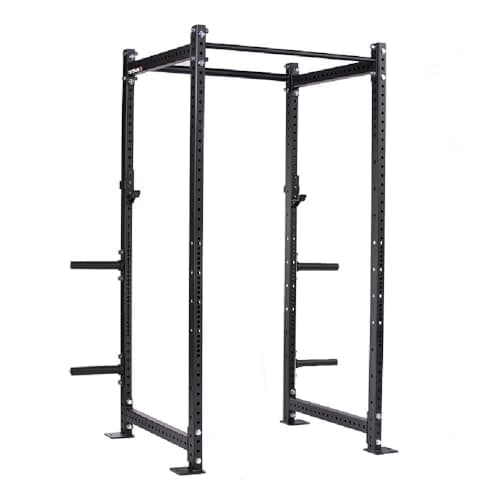
The best power rack under $1,000 is the Titan Fitness T-3 Short, because it is the only frame inside the ceiling that publishes a capacity figure and comes from a brand that will still sell you the parts that wear. It is for the lifter who wants a rack to be the last rack. The budget pick is the JELENS S11, a complete cage that arrives with a lat tower and attachments already on it for a fraction of the ceiling. Between those two sits the decision this page actually exists to make: at this price you are choosing between better steel and more stations, and almost every listing in the category is designed to make you choose stations.
A thousand dollars is a meaningful line in this category. Below about $300 you are buying a bare cage and hoping. Above about $1,500 you are into the brands that publish everything and warranty the frame for life. The band in between is where the interesting trade-offs live, and where most home gyms actually shop. If you want the tier-by-tier version of this argument it is on the best power racks by budget page; if your ceiling is lower than this one, the budget rack roundup is the right page.
How we ranked these
Four things decide whether a rack is still standing and still tight in a decade, and none of them is the number of stations on the box.
1. Published steel, in that order of preference
Upright size first, gauge second, rating third. A 3 × 3 inch upright is stiffer than a 2 × 2 inch upright of the same gauge, and it buys you into the hole-pattern ecosystem that most aftermarket J-cups, safeties and attachments are built around. Only one rack here publishes an upright size — the Signature fold-in, at 3 × 3 — and that is worth noting rather than glossing over. The full explanation of why the tube size matters more than the headline capacity is in 2 × 2 vs 3 × 3 power racks, and the gauge question has its own guide at power rack steel gauge.
2. Whether anyone will sell you a part in year eight
This is the spec no listing prints and the one that decides whether a rack is permanent. A J-cup liner wears. A pop-pin bends. A pulley cable frays. On a rack from a brand with a catalog and a parts process, each of those is a small order. On a rack from a marketplace label that will not exist in three years, each of them is the end of the rack. Titan is the only brand on this page with a documented replacement-part route, which is most of why it wins — and the general case for buying this way is in replacement parts for home gym equipment.
3. The honest cost of a cable system
Three of the six racks here include cables, and cables change the arithmetic. A welded or bolted steel frame has essentially nothing to wear out; a pulley stack has a cable, a bearing surface, cable ends and a traveling carriage. Every one of those is a consumable on a long enough timeline. That is not an argument against cable racks — a lat pulldown and a low row are the two things a barbell genuinely cannot do, and buying them inside the rack is far cheaper than buying them separately, as the cable rack roundup works through. It is an argument for knowing what you are signing up to maintain.
4. Footprint, measured honestly
A cage needs its own floor and a safe working envelope around it. A folding wall-mounted rack needs structural studs and gives the floor back between sessions. A short rack solves a headroom problem and creates a pull-up problem. None of these is better in the abstract — they are answers to different rooms, and how much space you need for a power rack is the page that turns your room into a shortlist.
What $1,000 actually buys, and what it does not
It buys enthusiast-tier steel with published numbers and a parts trail. It buys a 3 × 3 upright in a rack that folds flat to a wall. It buys a complete cable crossover station attached to an enclosed cage. What it does not buy is all of those at once, and any listing suggesting otherwise is counting stations rather than specifying steel.
It also does not buy a lifetime frame warranty. That is the honest ceiling of this band: the brands that warranty a rack frame for life sit above it. What you can get inside $1,000 is a published capacity, a documented parts process and steel thick enough that the warranty rarely comes up — which, for a home gym, is most of the way there. The warranty landscape across the whole market is mapped in lifetime warranties on home gym equipment.
One more thing it does not buy: a rack that is safe without being anchored or loaded. Two of the picks here bolt to a wall, and the free-standing cages all want their plate posts loaded or their feet bolted down before you fail a heavy squat in them. That is not a defect of cheap racks; it is physics, and it is covered in do you need to bolt down a power rack.
Steel versus stations: the actual decision
Here is the clearest way to put it. The Titan publishes 1,100 lb and nothing else; the JELENS publishes 2,000 lb and includes a cable tower, and costs less than half as much. Read naively, the JELENS wins on every axis. Read properly, those two numbers are not measuring the same thing: a headline rating on a budget frame tells you about the steel's theoretical strength, not about how much the uprights deflect when you rack a heavy bar, and not about whether anyone will sell you a replacement J-cup in 2034.
So the question is which failure you would rather have. A cable rack gives you more movements today and a maintenance item in five years. An enthusiast frame gives you fewer movements today and essentially no maintenance ever. For a lifter whose program is squat, bench, deadlift and press, the frame is the better buy and a band set covers the accessory work. For a lifter who wants pulldowns, rows and crossovers in one footprint, the cable rack genuinely is the cheaper path — buying a cage and a lat tower separately costs more than either cable rack here.
The two folding picks are a third answer: the Signature fold-in gives you the heaviest upright on the page in a frame that disappears against the wall, and the Mikolo gives you a crossover and a pulldown in the same wall footprint. Both need studs. Both are the right call if the room has to be a room again afterwards, and the folding rack roundup compares them against each other in more detail.
Who each pick is for
Titan T-3 Short — you want the last rack you buy, you have a low ceiling or a basement, and you do not care about cables. Our longer read is the T-3 Short review. Mikolo folding cable rack — you have a solid wall and want a crossover, a pulldown and a squat rack in the same square of floor. JEEKEE cable cage — you want the closest thing to a commercial functional trainer plus an enclosed cage, and you will never move it. Signature 3 × 3 fold-in — you want commercial-size uprights and your garage has to hold a car again on Saturday. SPORTSROYALS rack — you want the cage and the cable stack in one box at the lower end of the band. JELENS S11 — you want the most equipment per dollar on this page and you accept that the cable assembly is the part that will date.
If none of these is quite right, the two neighboring shelves are the best power cages for enclosed four-post frames specifically, and the best power racks for a low ceiling if headroom is the binding constraint. One cheap addition earns its place inside any of these frames: a box, for box squats and step-ups, ranked on the best plyo boxes page. A rack is also only half a bench press — the best benches for a power rack is the other half.