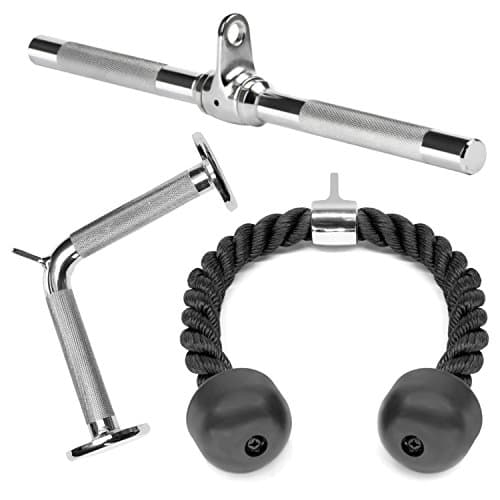
A cable tower is a pulley and a stack of weight. The attachment on the end of the cable is what turns it into a pulldown, a row, a pressdown, a face pull or a curl — which makes roughly forty dollars of hardware the difference between one exercise and ten. That is the strongest value argument anywhere on this site, and it is why the hardware is worth a page of its own rather than a footnote on the rack-with-cables roundup.
It is also the least honest category we have covered. Not one of the five listings ranked below publishes a load rating — on items you hang your entire bodyweight or a full stack from. One publishes a width. None publishes a bearing type. So instead of pretending to specs that do not exist, this page ranks on the handful of things the listings do commit to, explains which shapes earn their place on a home tower, and is explicit about where a figure is simply not published. Live prices are read from the Amazon Product API and date-stamped; nothing is typed into prose.
How we ranked them
- Coverage per purchase. How many exercises the shape genuinely covers. A double-D handle does rows, close-grip pulldowns and pressdowns; a W-shaped lat bar does pulldowns and nothing else. In a home gym with one cable, coverage is the dominant criterion.
- Material and construction. Aluminum alloy will not rust in a garage; coated steel will if the coating chips; a rope sheath is a consumable. One-piece welded hardware has nothing to service.
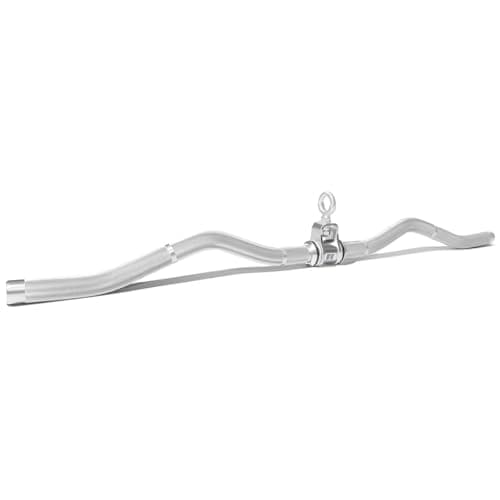
- Swivel. A rotating bar lets your wrists find their own angle under load, and it is the only moving part in this category worth paying for. A fixed handle makes your joints follow its geometry.
- What the listing publishes. Width, length, material. A listing that commits to numbers can be held to them, and in a category this quiet that willingness is a quality signal in itself.
As everywhere on this site, these are judgments from documented research — the live listings, the materials involved and aggregated owner reports, scored against our published rubric. We do not run a testing lab.
Will it even fit? Check this first
Cable attachments are near-universal, but “near” is doing work in that sentence. Three checks before you order anything:
- The hook or carabiner. Most towers ship with one snap hook, which is already on the attachment that came in the box. If the new attachment does not include its own hook, you will be swapping one hook between handles forever. Two of the picks below include hooks or a carabiner and we weight that.
- The eyelet and the clevis gap. A thick welded eyelet will not pass through a narrow snap hook. There is no standard, and almost no listing publishes the eyelet dimension, so the practical move is to photograph your existing hook and compare it against the product photos.
- Your ceiling and your cable travel. A 38 in pulldown bar needs the room to pass your head on the way up, and a long rope eats cable travel on a low pulley. Our page on functional trainer space requirements has the measuring method.
The five, side by side
| As published | A2ZCARE combo | RitFit lat bar | Yes4All rope | Howffite double-D | Yes4All D handle |
|---|
| What you get | Rope, rotating bar, V-bar, 2 hooks | One pulldown bar | One rope | One welded handle | One single handle |
| Published size | Not published | 38.6 in wide | 27 in and 36 in | Not published | Not published |
| Material | Not published | Aluminum alloy | Not published | Steel | Not published |
| Swivel | Rotating straight bar | Full rotation | n/a (rope) | None | None |
| Hook included | 2 snap hooks | Not published | Carabiner included | Not published | Not published |
| Load rating | Not published | Not published | Not published | Not published | Not published |
That bottom row is the story of the category: five listings, zero load ratings. We looked for one — a Yes4All straight bar does publish a 980 lb figure, but it was unavailable when we checked, so it is not ranked here. Treat every attachment as rated for less than you think, inspect the weld and the eyelet when it arrives, and do not leave a stack hanging on a handle you have just dropped on concrete.
The shapes, and which ones a home gym needs
The rope
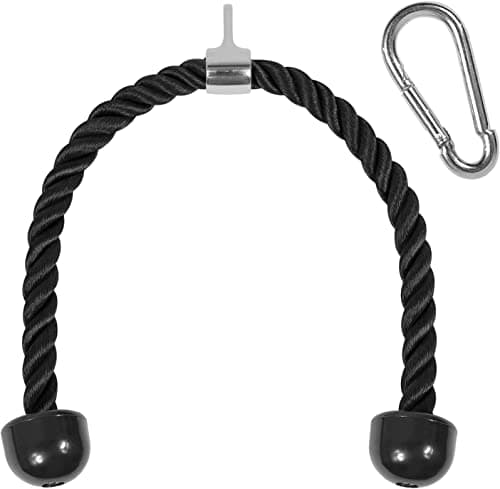
The most-used attachment in most home gyms, because it does the most jobs: pressdowns, face pulls, rear-delt work, cable crunches, hammer curls. A long rope (the 36 in option on the pick below) lets your hands separate on face pulls, which a short rope cannot. It is also the only attachment with a genuine wear life — the sheath fuzzes where it rolls over the pulley — so treat it as a consumable rather than a keeper.
The double-D or V-bar
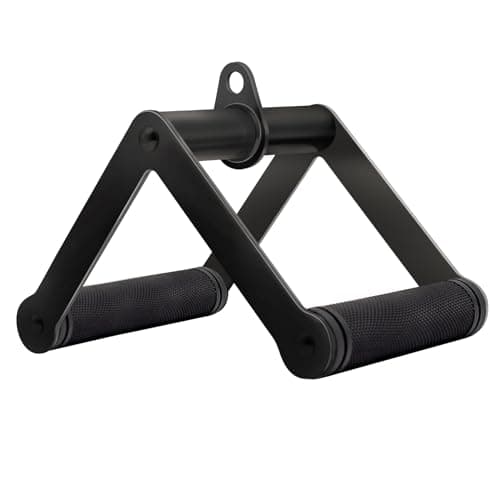
Two angled handles on one welded frame. On a low pulley it is the seated row; on a high pulley it is a close-grip pulldown; at chest height it is a pressdown. If you buy exactly one attachment beyond whatever came in the box, this is the one with the best odds of being used every session.
The lat pulldown bar
Long, usually angled at the ends, and the only shape that lets you load a wide-grip pulldown properly. The spec that matters is width, because a bar narrower than your natural pulldown grip quietly turns the exercise into something else — and it is the spec almost nobody publishes. If it is your hands rather than your lats that end a heavy set of pulldowns, the cheaper fix is a pair of lifting straps. Attachment bars are also the usual upgrade path for an owner of a bolt-on lat tower, which often ships with a short bar.
The single D handle
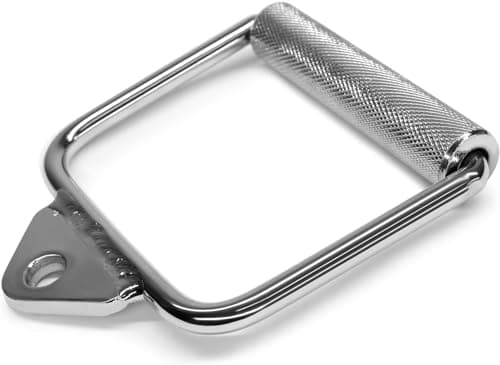
One handle, one hand. Unilateral rows, cable curls, single-arm pressdowns and the kind of side-to-side correction work a double handle physically cannot do. They are sold individually, which is the detail that catches people out: a pair is two orders.
The straight bar
Curls, pressdowns and upright rows, and genuinely nice to have — but it is the shape whose job overlaps most with others, which is why the kit pick below (which includes a rotating straight bar) is a better route to it than buying one on its own.
Kit or singles?
Buy the kit if you own a bare tower, a cable rack or a functional trainer that shipped with one handle. Three pieces plus two hooks for less than two pieces bought separately is not a close call, and the spares let you leave a handle on each pulley of a dual-cable machine instead of re-hooking between exercises.
Buy singles if you already have a drawer of attachments and one specific gap — usually a long rope or a wide lat bar, because those are the two that budget kits skimp on. The one thing we would not do is buy a kit to get a lat bar: kit bars are short, and width is the one spec that actually changes the exercise.
If you have not bought the cable hardware yet at all, the prior decision is which cable source you want. That argument is on power rack with cables vs functional trainer, with the stack mechanics in cable machine weight stacks explained.
What breaks, and what it means for your pulley
Attachment failures are cheap and attachment-caused failures are not, which is the asymmetry to keep in mind. The handle is ten or forty dollars; the cable, the pulley and the stack behind it are the machine. Three things to watch:
- The eyelet weld. Every load you hang passes through one weld. Look at it when it arrives and look again after a year; a weld that has opened up is a replace-today item, not a next-payday item.
- The rope sheath. Fuzzing is normal, exposed core is not. A failing rope can shed fibers into the pulley groove, which is how a cheap consumable turns into a machine problem.
- Grip rubber shearing. Rubber grips split along the seam and then spin on the steel. Annoying rather than dangerous — but a spinning grip on a heavy row is exactly how people let go of things.
The broader service-life picture for the machine these hang on is how long cable machines last, and the parts-availability question that decides it is home gym replacement parts.
Where the money goes
Brackets, not numbers, because the live figures in the table stay correct and prose does not. The bottom bracket is a single steel handle from a known accessory brand: a few dollars, no published specs, and genuinely fine for what it is. The middle bracket is a rope or a welded double-D with a carabiner included, which is where most home gyms should spend. The kit bracket buys three pieces and the hooks to hang them, and is the best value on the page. The top bracket here is a single dedicated bar in aluminum alloy that publishes its width and swivels — several times the price of a kit bar, for one exercise done properly. Everything on this page together still costs less than one bumper plate set, which is the cheerful part: the attachments are the last place a home gym budget gets tight. The arithmetic for the rest of it is home gym cost per year.
Buying cable hardware without a spec sheet
Start from the exercises you are missing, not the catalog
Write down the three cable exercises you want that you cannot currently do. In most home gyms the answer is face pulls (long rope), seated rows (double-D) and wide pulldowns (a proper bar). Buy those three and stop; a drawer of unused attachments is the normal failure mode in this category.
Prefer the listing that commits to a number
When two attachments look identical in photos and one publishes a width, a length or a material, buy that one. It is not that the number is magic — it is that a seller willing to be specific is a seller who expects to be measured.
Buy the hook with the handle
A snap hook or carabiner costs almost nothing and its absence is genuinely irritating: you cannot use the new handle and the old one at the same time. Check the box contents line before checkout.
Rotating beats fixed on anything you pull hard
A swivel is the one upgrade in this category your joints will notice. On pulldowns and curls it lets your wrists pronate naturally through the range; on a fixed bar they follow the bar. If a rotating version of the shape you want exists within budget, take it.
Aluminum for a garage, steel for a basement
An unheated garage rusts anything with chipped coating, and attachments get dropped, so coatings chip. Aluminum alloy sidesteps the problem entirely. In a climate-controlled room it does not matter and steel is cheaper. The same logic as keeping a garage gym from rusting.
Treat ropes as consumable and handles as permanent
Budget for replacing a rope every few years and for never replacing a welded handle. That split tells you where to spend: buy the cheap rope and the good handle, not the other way round.