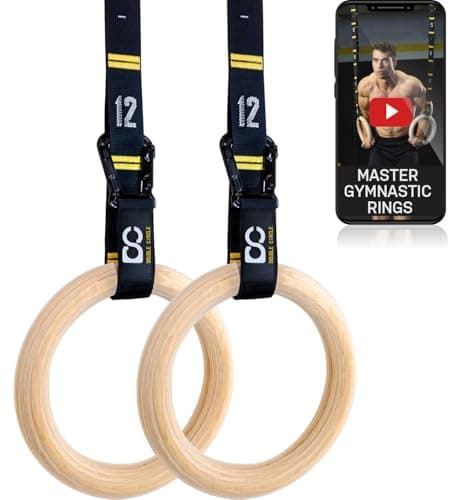
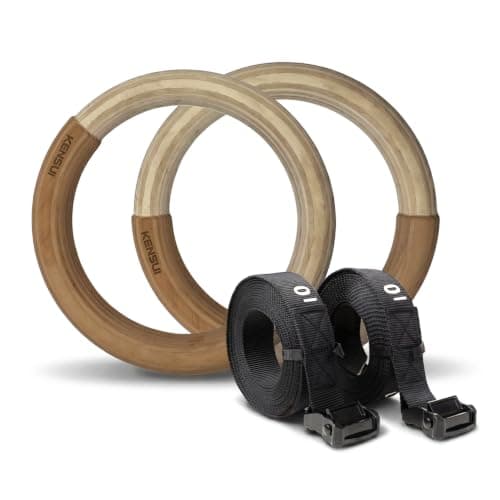
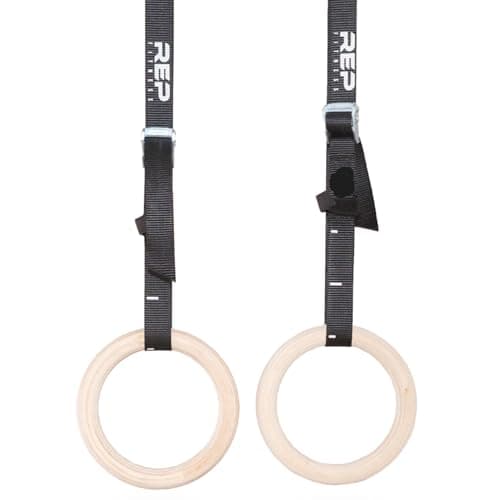
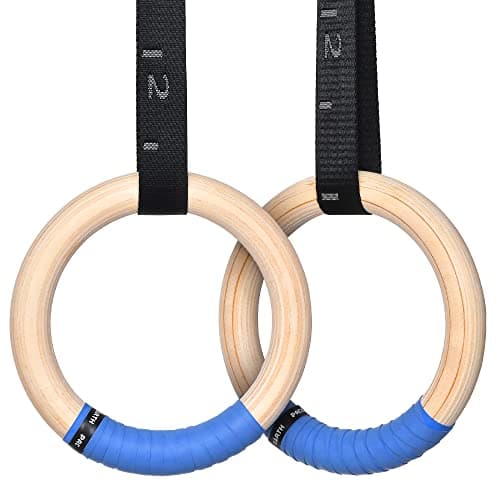
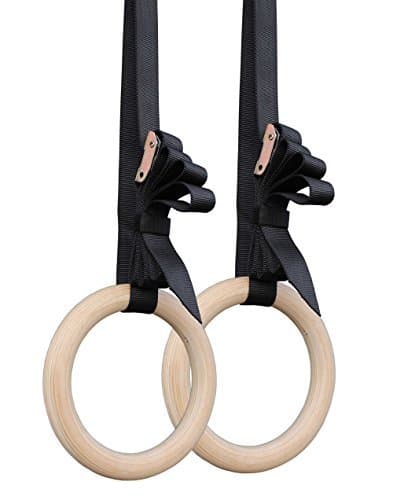
A pair of wood gymnastic rings is the highest ratio of movements-added to money-spent of anything in this entire site, and the only part of it with a service life shorter than “decades” is the webbing. Birch rings do not rust, do not peel, cannot delaminate and get better with chalk. The straps are nylon webbing and a buckle, they are the part that ages, and on a good set you can replace them without replacing the rings. That is why this page ranks on published diameter, published strap length and whether the parts are separately available — not on the exercise poster in the listing photos.
Rings belong on this site for a specific reason: the home gyms we write about already contain something to hang them from. If you own a power rack, a pull-up bar or a power tower, a ring set adds dips, rows, push-ups at depth, chin-ups at any grip angle, face pulls, ab work and the entire gymnastic progression for the price of a couple of fractional plates. Every price here is read live from the Amazon Product API and date-stamped underneath.
How we ranked them
Five criteria, in this order:
- Ring material. Wood or nothing, and we will defend that below. All five sets here are wood, which is why the material is the entry requirement rather than the differentiator.
- Published ring diameter. 28 mm is the competition size and the one gymnasts train on; 32 mm is thicker and more comfortable for most adults doing dips and pull-ups. This is the single biggest difference in how a ring feels, and only two of five listings state it.
- The strap system. Published length (can you actually reach your joist?), buckle type, and whether the webbing is numbered or scaled so both rings return to the same height without measuring. Numbered straps sound like a gimmick until the first time you set up in the dark.
- Hardware and what the listing claims about it. A stated load rating tells you the buckle was treated as structural. A load claim four times larger than anybody needs tells you something else, and we say so.
- Parts availability. Straps wear out first. A brand that sells rings on their own, or straps on their own, is a brand whose product does not become landfill when one half ages.
We do not run a lab and we do not pretend to. These are judgments from the published listings, the materials involved and aggregated owner reports, scored against our published rubric.
The five, side by side
| As published | Titan Fitness | Double Circle | KENSUI Duo | REP Fitness | PACEARTH |
|---|
| Ring material | Wood | Wood | Birch wood | Wood | Wood |
| Published diameter | 28 mm | 1.25 in (32 mm) | 28 mm and 32 mm | Not published | Not published |
| Published strap length | 16 ft | Not published | 16 ft | Not published | 14.76 ft or 9 ft |
| Load figure | 600 lb rated | Not published | Not published | Not published | 1,500/1,000 lb claimed |
| Strap adjustment | Cam buckle | Numbered quick-adjust | Not published | Numbered | Cam buckle with printed scale |
| Rings sold separately | Not published | Yes, as a rings-only listing | Not published | Not published | Not published |
Every cell is quoted from the manufacturer listing linked in Sources, and where a listing states nothing the cell says so rather than guessing. Two things stand out. First, two of five publish the ring diameter — the spec that decides how the product feels in your hand. Second, the only listing that publishes a load rating that reads like an engineering figure is also the only one that publishes everything else; and the listing with the biggest number on it publishes the least of substance.
28 mm or 32 mm
This is the decision, and it is worth two minutes before you spend the money.
28 mm is the competition diameter used by gymnasts. It is easier to get a false grip on — the wrist-over-the-ring position that muscle-ups and front levers need — and it feels thin and quick in the hand. It is also harder work to hold for a long set of dips, especially if you are a heavier adult, because less of the ring is in contact with your palm.
32 mm (sold as 1.25 in) is the thicker ring. It spreads the load across more of the hand, which most adults find more comfortable on dips, rows and chin-ups, and it is the right default if you are not training gymnastics skills. The trade is a harder false grip and a slightly less nimble feel.
If you genuinely cannot decide, the KENSUI set here publishes both: one ring with a 28 mm side and a 32 mm side that you choose by rotating it. It is bulkier than a single-diameter ring and it is the newest listing on this page, but it removes the only irreversible choice in the category.
Wood, plastic or metal
Buy wood. The argument is not aesthetic:
- Grip when warm. Plastic rings get slick as soon as your hands are damp. Wood stays grippy, and it takes chalk, which plastic effectively does not.
- Nothing to peel or craze. A plastic ring is a molding with a surface finish that eventually crazes; a wood ring is the material all the way through. There is no coating to fail, which is the same reason this site prefers bare cast iron over painted plates.
- Metal is the wrong answer entirely. Cold, unforgiving, and it transfers heat out of your hands in an unheated garage. Steel rings exist; nobody who has used them in winter buys a second set.
The one honest advantage of plastic is price and weather resistance — if the rings live outdoors year-round, a plastic set is the pragmatic buy. For anything hanging in a garage, basement or spare room, wood is the item you keep.
Where you hang them, and what that has to hold
This is the part most ring pages skip, and it is the part that determines whether the purchase is usable. You need an overhead anchor, an honest assessment of what it can take, and enough strap to reach it.
- A power rack pull-up bar. The best option in most home gyms: the bar is already rated, the uprights are already loaded, and the rings hang inside a frame you can also use for everything else. Strap over the bar rather than clipping to it, and keep the rings inboard of the uprights so you do not swing into steel. If your rack has no pull-up bar yet, rack attachments covers that.
- An exposed joist or beam. Excellent if it is structural and you can get a 16 ft strap over it. A single joist in a finished ceiling is not the same thing as an exposed beam — if you cannot see what the load path is, do not invent one.
- A wall- or ceiling-mounted pull-up bar. Works, provided the bar’s published rating covers your bodyweight plus the dynamic load of swinging on it. Our ranked bars are on the pull-up bar page, and the mounted ones publish ratings from 300 lb upward — read them, because rings are harder on a mount than a dead hang is.
- A doorway bar. No. A pressure-fit or doorframe bar is not a ring anchor and nobody rates one for it.
- A power tower. Some towers have a top bar you can strap to, but a free-standing tower can tip when the load swings away from its base. Check the tower’s own rating and footprint first — see the calisthenics tower roundup for which frames are built for it.
Strap length is the practical constraint nobody thinks about until the rings arrive. A 16 ft strap is two 8 ft legs: plenty for a rack bar or a standard basement joist, tight for a high garage rafter. Three of the five sets here publish a length and two do not, which is a real reason to prefer the ones that do.
What actually wears out
In this order, over years:
- The webbing, at the ring and at the buckle. Nylon abrades where it passes through hardware and fades where sunlight reaches it. A garage door window will age a strap faster than the training will.
- The buckle. A cam buckle has a moving part and a bent cam is not repairable. A plain buckle has nothing to bend but is slower to set. This is the only moving component in the whole product.
- The ring surface, eventually. Wood goes smooth where your hands go, and that is a chalk problem rather than a replacement problem. A cracked ring is a retirement, and it is rare enough that cracked rings are mostly a story about rings left outdoors through a freeze.
Which is why the parts question matters: Double Circle sells the rings as a separate listing, so a tired strap costs a strap rather than a set. That is the same repairability test this site runs on everything from racks to dumbbells — see home gym equipment lifespan.
Rings against the alternatives
Rings are the cheapest way to add movements, not a substitute for structure. Three honest comparisons:
- Rings vs a dip station. Ring dips are harder than bar dips at the same bodyweight because you stabilize the rings as well as yourself, and that is both the appeal and the warning. If you cannot do ten clean bar dips, fixed bars first.
- Rings vs a power tower. A tower is a frame with a footprint; rings are two objects in a drawer. If space is the constraint, rings win outright — and if you want the tower anyway, are power towers worth it answers that separately.
- Rings vs added load. At some point rings stop being the limiting factor and you want weight on your bodyweight work. That is a dip belt, and it works on rings exactly as it does on a bar.
Where the money goes
We describe brackets rather than price them, because the live figures in the table do that job and stay correct. The entry bracket is a wood ring set with a published strap length and a cam buckle, and it is a genuinely good buy — wood is wood. The value bracket adds numbered straps and a real equipment brand behind the product, which is where the REP set sits. The top bracket, which on this page is a difference of a few dollars rather than a different class of product, buys published specs: a stated diameter, a stated strap length and a stated rating, or both diameters in one ring.
Across the whole page the spread is less than the price of one 45 lb plate. For a buy-it-for-life gym that makes the decision easy: buy at the top of a range this narrow, get the published numbers, and never think about rings again. The same arithmetic across the room is home gym cost per year.
Buying a set you will still own in twenty years
Buy wood, and do not overthink the species
Birch is what most wood rings are, and it is named explicitly on one listing here. What matters is that it is wood at all: grip when warm, chalk compatibility, and no coating to fail.
Pick the diameter for the training you will actually do
32 mm for dips, rows and chin-ups, which is most people. 28 mm if you are working toward gymnastic skills and a false grip. If you cannot choose, the dual-diameter set removes the decision for about the same money.
Measure the anchor before you buy the straps
Stand where the rings will hang and measure from the anchor to the floor. You need roughly double that in total strap, plus tail for the buckle. A 16 ft published strap covers most rooms; an unpublished one is a gamble you resolve after delivery.
Numbered or scaled webbing is worth paying for
Both rings level, at the same height, every session, without a tape measure. It is the single feature owners mention most and the one that gets skipped in listings that would rather show you an exercise poster.
Buy the parts question, not the load claim
A ring set does not need a four-figure load rating; your bodyweight plus some dynamic load is the real number. What it does need is the ability to replace a worn strap. Prefer a brand that sells the rings and the straps separately over one that prints a very large number.
Hang them where you can leave them
The rings you use are the rings that are already hanging. If setup takes five minutes you will train on them twice. A rack pull-up bar or an exposed joist, strapped once and left, is what makes the purchase stick.