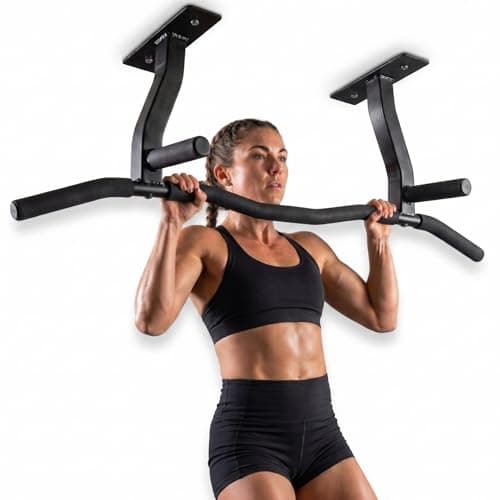
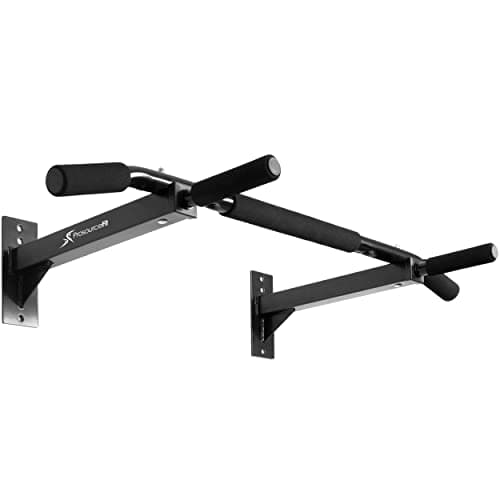
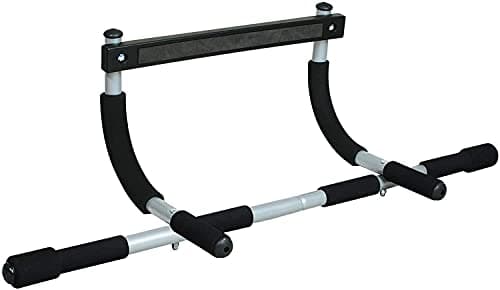
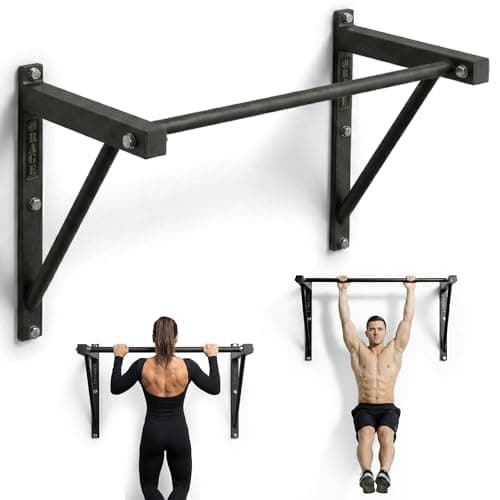
The best pull-up bar under $100 is the Rage Fitness R2, because it is the only bar in the band that publishes a gauge as well as a rating and the only one with 36 inches of wall clearance. It is for anyone with studs or joists to bolt into who wants the bar to be a fixture rather than a fixture-shaped compromise. The budget pick is the Iron Gym doorway bar, which needs no screws and costs about a third of the ceiling. The finding this page exists to report is simpler than a ranking, though: every mounted pull-up bar worth owning already sits under $100, so the price is the least interesting thing about this purchase.
What that means in practice is that the decision moves from the bar to the building. A 500 lb bar bolted into drywall holds nothing; a 300 lb bar lagged into two structural studs holds anyone reading this. So the ranking below is organized by what you have to mount into, and the ratings are read second. If you would rather buy a frame that needs no wall at all, the comparison is power tower vs pull-up bar, and the band that reaches those frames is the pull-up bars under $500 page.
How we ranked these
Four things decide whether a pull-up bar is still solid in a decade, and only one of them is printed on the box.
1. What it mounts into, honestly
Three mounting classes, three completely different answers. A wall mount wants two structural studs and lag bolts into the center of them. A ceiling mount wants joists, and it is the better option in a garage or basement where the joists are exposed and you can see what you are hitting. A doorway bar wants a sound trim and a frame, and carries nothing into the structure at all - it wedges. We rank by how well each one matches a real room rather than by rating.
2. Clearance, which decides whether you can use it
This is the spec buyers discover after the holes are drilled. A bar mounted 10 inches from the wall means a pull-up with your knees tracking into the plaster; 36 inches means a full hang, knees up, kipping if you want to. Only one bar here publishes 36 inches. On a ceiling mount the equivalent spec is how far below the ceiling the bar sits, because your head needs somewhere to go at the top.
3. Published rating, read against the fixing
One bar in the band publishes 500 lb and four publish 300 lb. Every one of those is a figure for the steel, not for the system - and the system is the bar plus the fixings plus the structure, which is always weaker than the bar. A 300 lb bar into solid studs is a stronger installation than a 500 lb bar into a single stud and a drywall anchor. The same reasoning applies to rack-mounted bars and is worked through on power tower weight limits explained.
4. Grips, last
Multi-grip bars are genuinely useful - neutral and wide grips change what the movement trains, and three of the bars here publish more than one grip position. It is ranked last because a single straight bar at the right height in a solid wall beats a six-grip bar in a wall you do not trust. Rings do more for the same money if what you want is variety, and those are on the gymnastic rings page.
What $100 actually buys, and what it does not
It buys 11-gauge steel, a 500 lb rating and 36 inches of clearance. It buys a 42 inch joist-mounted bar with four grip positions. It buys two different doorway bars, one of which needs no tools at all. Inside this category, $100 buys the best available product rather than a compromise - which is unusual enough on this site to be worth saying out loud.
What it does not buy is a structure. Every bar here is a bracket and a tube; the load path runs through your fixings into your building, and that part is on you. Lag bolts into the center of two studs, found with a stud finder and confirmed by drilling a pilot hole, not by tapping. On masonry, proper sleeve anchors rather than plastic plugs. A bar that pulls out takes a piece of the wall with it.
And it does not buy a dip station or a rack. If you want pulling and dipping and pressing in one object you are looking at a tower or a rack, which cost several times this and take floor space a bar does not - compared on the power tower roundup and the dip bar page.
Drill or wedge: the actual decision
Here is the clearest way to put it. A bolted bar is rigid, has real clearance and will outlast the house. A doorway bar leaves no holes, moves with you and costs a third as much. Read naively, the bolted bar wins on everything. Read properly, the comparison only exists if you are allowed to drill and have something structural to drill into.
So the question is your building, not your budget. Own the place and have exposed joists or a known stud wall: bolt the Rage up and never think about it again. Rent, or have plaster over metal studs: buy a doorway bar and accept that it limits your range of motion in exchange for your deposit. The apartment case is covered in the apartment home gym guide.
There is a third answer worth naming: if you already own a rack, you already own a pull-up bar, and the money is better spent elsewhere. Almost every cage and half rack on this site carries a multi-grip bar across the top - which is one reason the squat racks with pull-up bars page exists. Buying a wall bar as well is a legitimate choice only if the rack bar is too low, which in a basement it often is.
Who each pick is for
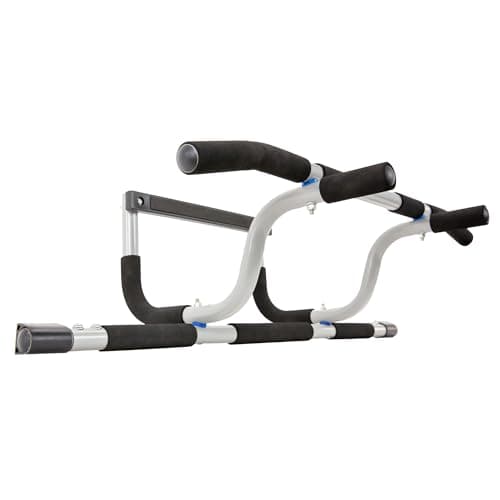
Rage Fitness R2 - you can bolt into studs or joists, you want the only published gauge in the band, and you want enough clearance for a full-range pull-up. Ultimate Body Press ceiling mount - your solid structure is overhead, the joists are at 16 or 24 inch centers, and you want a 42 inch bar with four grip positions; it is also the pick in a garage where the walls are block and the ceiling is timber. ProsourceFit wall mount - you want the cheapest permanent installation, you have wood or cement to fix into, and wide-and-close grips are enough. Ultimate Body Press XL doorway bar - you cannot drill, your opening is between 24 and 36 inches, and you want the published 10 inch standoff so your knees clear the door. Iron Gym - the budget pick: no screws at all, three grip positions, fits 24 to 32 inch doorways and comes down in seconds when the landlord visits.
Two cheap additions change what a bar can do. Rings hung from it turn one movement into a dozen - ranked on the gymnastic rings page - and a dip belt turns a bodyweight bar into a loaded strength station, which is the cheapest route to weighted pull-ups there is; the dip belt roundup ranks those. Do not hang a belt and plates from a doorway bar.