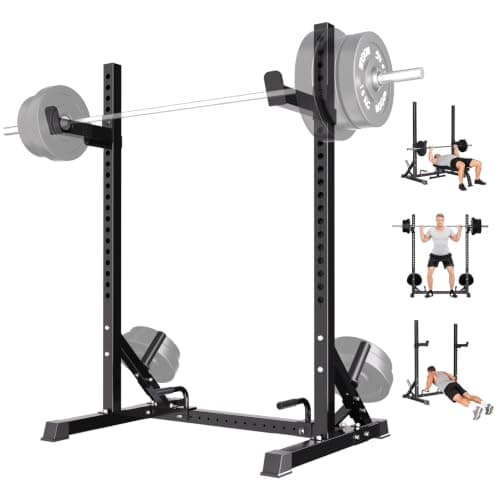
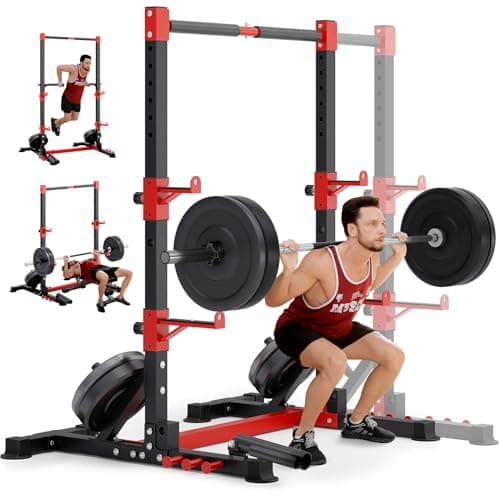
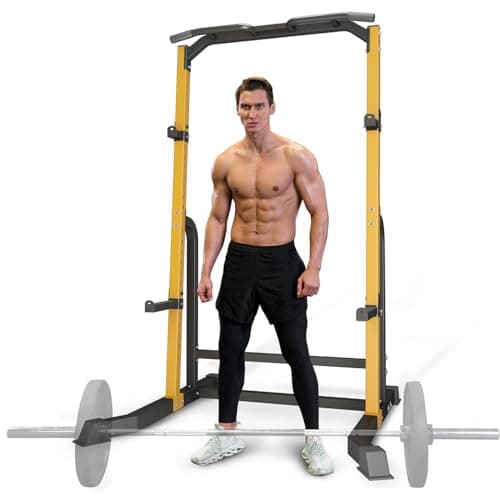
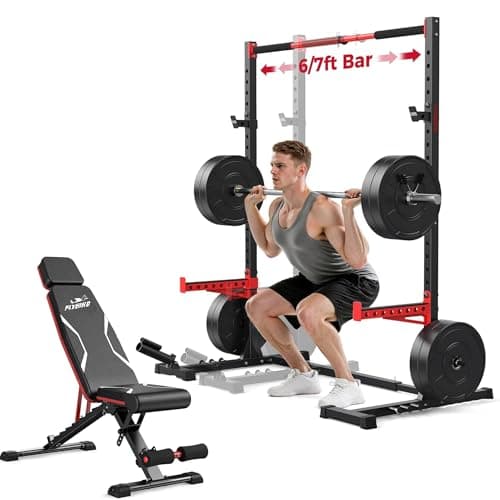
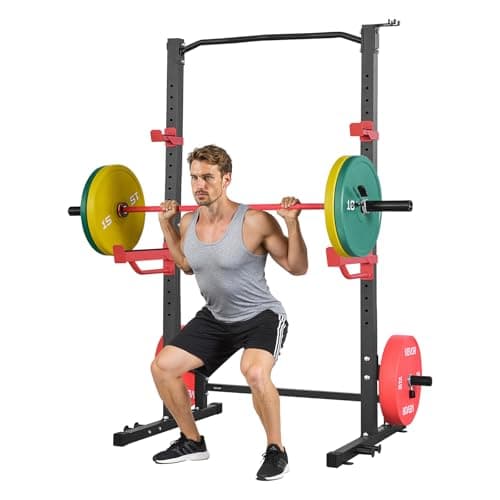
The best budget squat rack is not a squat rack: it is the VEVOR power cage, which at the bottom of the rack market gives you four uprights, safety bars in the box, a pull-up handle and a published 1,000 lb rating for roughly what a bare two-post stand costs. If you genuinely need a two-post footprint, the Garvee half rack and the YOLEO stand are the next two, and the reasons are below. Every rack on this page is 2 by 2 inch tube; the moment your budget stretches to 3 by 3 inch 11-gauge steel, this page stops applying and the main squat rack roundup takes over.
What a budget rack gives up — and what it must not
Every cheap rack saves money in the same places: thinner tube walls, smaller uprights, fewer or coarser hole positions, a shorter or absent warranty, and a lighter frame that leans on its rubber feet rather than on mass. Those are acceptable trades at the bottom of the market, and we say so. Two things are not acceptable at any price, and a rack that lacks either is not on this page:
- Safeties. Spotter arms, safety bars or safety straps that will catch a failed squat or bench. All five racks here ship them or, in the case of the two stands, include extended safety arms as standard. A stand with J-hooks only is a place to park a bar, not a place to train alone.
- A published capacity. A number the manufacturer is willing to print. The five here publish 1,000 lb, 1,200 lb, 1,000 lb, 800 lb and 950 lb. Those figures are manufacturer statements and we treat them as such, but a rack that states none is a rack whose maker will not stand behind it.
The framework for reading those specs — gauge, upright size, hole spacing — is the same one behind every rack ranking on this site: see power rack steel gauge explained and, for the two-post-versus-four-post decision, power rack vs squat rack.
The five, on the numbers they publish
| Rack | Type | Rated | Uprights | Safeties | Pull-up bar | Positions |
|---|
| VEVOR power cage | Four-post cage | 1,000 lb | 2 x 2 in, powder-coated carbon steel | 2 safety bars, 7 levels | Single handle | 11 J-hook levels |
| Garvee half rack | Half rack | 1,200 lb overall; J-hooks 660 lb | 2 x 2 in, 2 mm wall | Not listed — J-hooks and push-up bars | No | 21 |
| YOLEO squat rack | Adjustable-width stand | 1,000 lb | Fixed 83 in frame, base 54.7 x 43.7 in | 16.5 in safety arms | Yes, 71.5–80.5 in | Width 35–67 in |
| ZENOVA squat rack | Stand with H base | 800 lb | 2 x 2 in | Spotter arms, 21 levels | Multi-grip | 21 |
| FLYBIRD SR1 | Compact rack with bench | 950 lb | 2 x 2 in, 1 in holes | 16.7 in safety arms | Foam-padded | 22 |
One correction to the table is worth stating in prose: the Garvee listing describes J-hooks, push-up bars, plate storage and a bar holder, and does not list spotter arms. It ranks second on the strength of its published 2 mm wall and 1,200 lb overall rating and its 11.24 square foot footprint — but if you will bench alone in it, budget for a pair of safety straps from the safeties comparison before you budget for anything else.
Why a cage wins a squat rack page
Because at this end of the market the four-post cage is not more expensive than the two-post stand. At our last price check the VEVOR listed below most of the stands on this page — the live prices above will tell you whether that still holds — and for it you get safety bars that span the full width of the cage rather than arms that stick out of two posts, plus four plate storage holders, band pegs and a pull-up handle. It covers 17.7 square feet by its own listing, which is more than the Garvee's 11.24 but not by as much as people assume.
The stand still wins when depth is the constraint — a cage needs you inside it, a stand lets you walk the bar out — or when the room simply will not take a box. If that is you, read the best squat racks for small spaces alongside this page; the overlap is deliberate, because the smallest rack and the cheapest rack are often the same rack.
The point at which spending more pays back
On a buy-it-for-life site, the honest budget question is not "what is cheapest" but "where does the next dollar stop buying durability". On racks the answer is clear. Everything on this page is 2 by 2 inch tube. The step up is 3 by 3 inch 11-gauge — the Signature SF-SS1 in our main roundup publishes exactly that, with 47 hole positions, Westside spacing through the bench zone and a frame that weighs 155 lb against the VEVOR's 59.75 lb. That mass is why it does not need to be told it will not wobble.
Run the cost per year math and the picture is: a budget 2 by 2 rack that you keep ten years is cheap by any measure, and a 3 by 3 rack you keep twenty-five is cheaper still per year but costs several times more up front. If the up-front money exists, buy the 3 by 3 once. If it does not, buy the VEVOR, buy the safeties, and do not feel you compromised on the training — every lift on it is the same lift.
What we would not buy at this price
A stand with no safeties. A rack whose listing gives no capacity. Anything described as "heavy duty" with no wall thickness or gauge behind the phrase. And a rack you intend to load with a lat pulldown attachment — the cheapest frames are not the ones to hang a cable stack off, and the cable racks worth buying are ranked separately in the best power racks with cables.
How to buy a cheap rack without buying it twice
Buy the safeties before the plates
If the rack ships without spotter arms or safety bars, that is the first accessory, not the last. A pair of straps costs less than the plates you will add in month two and is the difference between a failed rep and a trip to the emergency room.
Check the bar it fits
Three of the five say they fit both 6 ft and 7 ft bars. A 7 ft Olympic bar is around 86 inches long — our barbell roundup lists the CAP Beast at 86 — so a stand set narrow for a 6 ft bar may not take it. The YOLEO adjusts from 35 to 67 inches wide, which is the most flexible answer on the page.
Anchor a stand, or give it mass
A light two-post stand tips before it bends. Anchor it if the floor allows — the method is in how to anchor a squat rack — or load the plate storage so the base has weight on it. Both are free; a rack walking under a re-rack is not.
Assume the warranty is short
The ZENOVA listing states one year. The others state none on the page we read. Do not buy a budget rack for its warranty; buy it for the steel spec, and read what a lifetime warranty actually covers before you decide the step-up rack is worth it for the paper alone.
Re-torque, then re-torque again
Bolt-together budget frames settle. Tighten every bolt after the first week of use and again a month in. A rack that rattles is nearly always a rack that was never re-torqued.