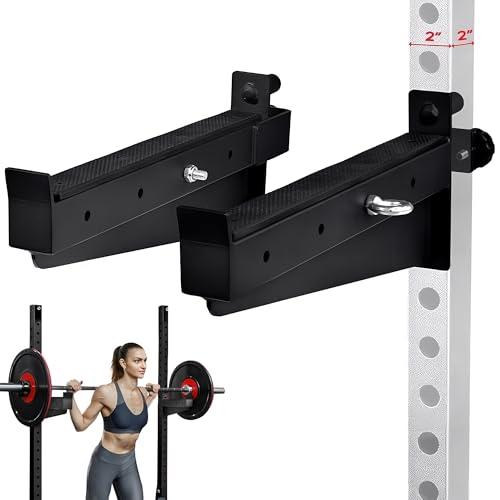
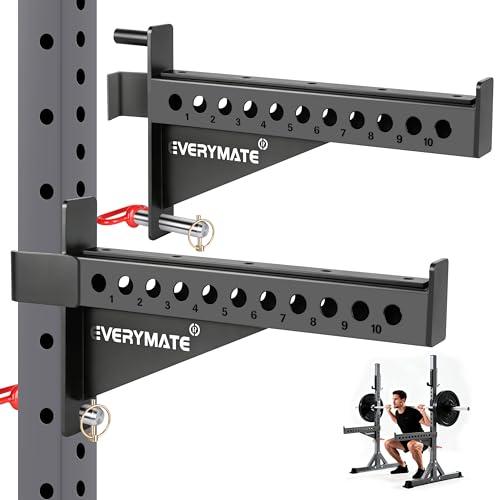
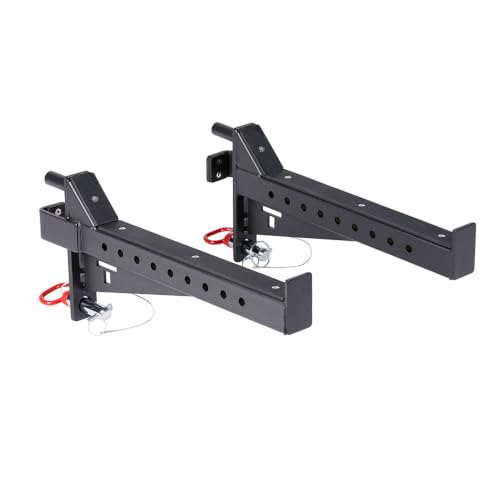
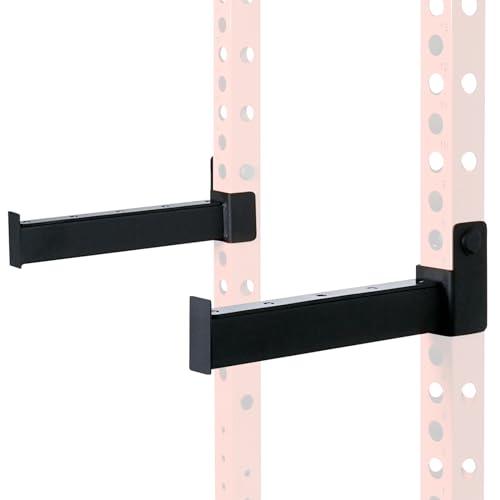
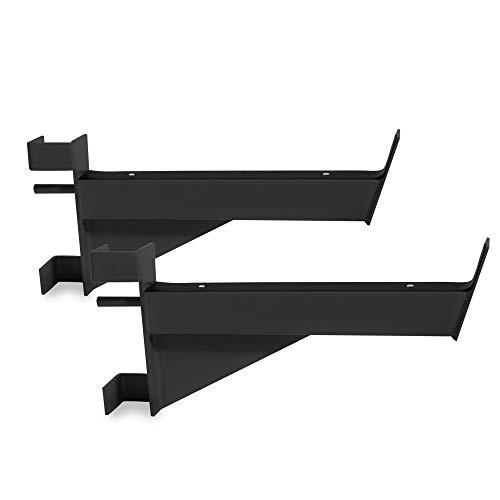
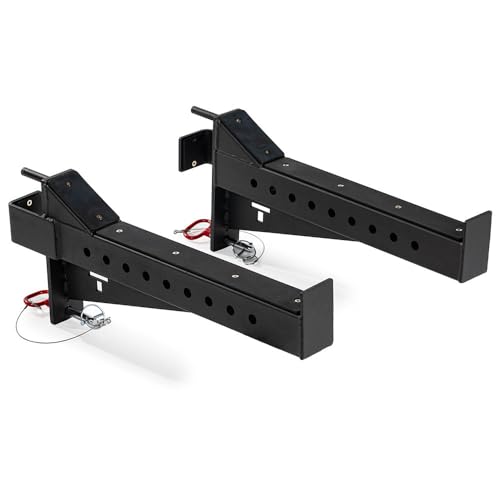
The best spotter arms are the Titan Fitness X-3 Series pair, because a published 1,500 lb capacity is roughly twice what anything else in the category prints and because Titan will still sell you the pin. They fit the 3 x 3 inch upright with 5/8 inch hardware. If your rack is 3 x 3 with 1 inch holes, the EVERYMATE pair publishes 1,000 lb and a 37 lb pair weight for about half the money; if it is 2 x 2, the Yes4All arms publish 1,000 lb and add a UHMW face that spares your knurling. The budget pick is the CAP FM-905Q pair. Fitment decides this purchase more than ranking does, so measure before you read any further.
Spotter arms are the least glamorous and most useful thing you can bolt to a rack. They are what turns an open squat stand or a half rack from a frame you must not fail in into a frame you can. Most home lifters train alone; most of them have no catch bars; and the gap between those two facts is where the serious accidents in home gyms happen. If you are still choosing between steel arms and nylon straps, the trade-off is worked through in safety bars vs safety straps, and the short version is below.
Measure these two things before you shop
Nothing else matters if the pin will not go through the hole.
1. The outside dimension of the upright
The three sizes in the wild are 2 x 2 inch, 3 x 3 inch and 2.36 x 2.36 inch (60 mm), and a large slice of budget racks use that last one — which is why it has exactly one live option on this page. Measure the tube with a tape, not from the listing you bought it from, because listings round. Why the tube size matters for everything you will ever bolt to the rack is covered in 2 x 2 vs 3 x 3 power racks.
2. The hole diameter
This is the one people miss. Two racks can both be 3 x 3 inch and take completely different arms, because one uses 5/8 inch hardware and the other uses 1 inch. The Titan X-3 arms here are 5/8 in; the EVERYMATE arms are 1 in. Neither adapts to the other, and a pin that nearly fits is worse than one that does not fit at all, because it will seat badly and load one edge of the hole.
How we ranked these
Once fitment is settled there are four things worth judging, and two of them most listings skip.
1. Published capacity, and distrusting silence
An arm's job is to hold a bar you have dropped. Four of the six here publish a figure: 1,500 lb, 1,000 lb, 1,000 lb and 800 lb. Two publish nothing. We rank the published numbers at face value as manufacturer claims and we say plainly where there is no number, because on a safety part the absence of a figure is itself information. Note also that an arm's rating can exceed what the rack it bolts to is rated for — a 1,000 lb arm on a 2 x 2 frame is not a 1,000 lb system — so read both numbers together.
2. Steel mass, which is the honest proxy
One listing in this group publishes its own weight: the EVERYMATE pair, at 37 lb. That is the most useful number on this page after the capacity, because a heavy arm with a big rating is plausible and a light arm with a big rating is not. Where no weight is published we fall back on the published rating and the brand, and we say so rather than inferring a thickness. The general argument for judging steel by what is published rather than by feel is in power rack steel gauge.
3. What the bar lands on
Two picks here face the contact surface with UHMW — a hard, slippery plastic that takes the impact instead of your bar. Four are bare powder-coated steel. For a failed squat once a year, bare steel is fine and the mark is cosmetic. If you deliberately use the arms as a hard stop on every set of rack pulls or pin presses, UHMW is worth paying for, because a steel-on-steel stop chews the knurl and then the knurl stops gripping. What finishes survive and what they do not is in barbell coatings compared.
4. Whether a part is still orderable
The wear items are the pin or pop-pin and the UHMW face. Titan and CAP both have real catalogs and enough continuity that compatible hardware remains findable years later; the marketplace labels do not. On a safety component, we weight that more heavily than we would on a plate tree. The general case is in replacement parts for home gym equipment.
Arms or straps, in one paragraph
Steel arms are rigid, they set the bar at a precise height, and they double as a hard stop for rack pulls and pin presses. Nylon straps have give, which means they are kinder to the bar and to the frame when you dump a heavy squat on them, and they tend to publish lower ratings. Arms are the better default for most home gyms because of the second job — you can program against a fixed height — and straps are the better choice if you train close to failure often and care about the bar's finish. Both are better than the thing most people actually have, which is nothing. The longer version, with the two strap sets we rank, is in safety bars vs safety straps.
Setting them properly, which is free and skipped anyway
Arms bought and arms set are different things. Load an empty bar, get into the bottom position of the lift you are protecting, and set the arms one hole below the lowest point the bar reaches when you are still in control. Too high and they interrupt a good rep; too low and they catch you after your spine has already done the thing you were trying to avoid. Then test them with a weight you can definitely handle before you need them in anger — the first time you find out your arms are set wrong should not be the first time you fail a squat.
Two notes specific to open frames. On a two-post stand or a half rack, the arms are the only thing between you and the floor, so they are not optional — the shapes they attach to are ranked on the best half racks and the best squat racks under $500. And on any free-standing frame, arms add a leveraged load that tries to tip the rack toward you when the bar lands off-center; the frame wants to be anchored or its plate posts loaded before that happens, which is the argument in do you need to bolt down a power rack.
Who each pick is for
Titan X-3 arms — your rack is 3 x 3 with 5/8 in hardware and you want the highest published rating available, with a parts channel behind it. Yes4All 2 x 2 arms — your rack is 2 x 2, you want a published 1,000 lb figure, and the UHMW face and adjustable length are worth having. EVERYMATE 3 x 3 arms — your rack is 3 x 3 with 1 in holes and you want the best published rating per dollar; the 37 lb pair weight is the number that makes it credible. Titan T-2 arms — you own a Titan T-2 and you would rather have certain fitment and a parts route than the biggest number. RitFit arms — your uprights are 2.36 in, and this is the only live answer for that size. CAP FM-905Q arms — you own a CAP frame, you train at moderate loads, and the real comparison is not against the Titans but against having no catches at all.
The other attachment that changes an open rack for very little money is a landmine pivot, ranked on the best landmine attachments page. For the wider shortlist of what is worth bolting to a rack, see the best power rack attachments, and if the bench is the missing half of your setup, the best benches for a power rack is the page.