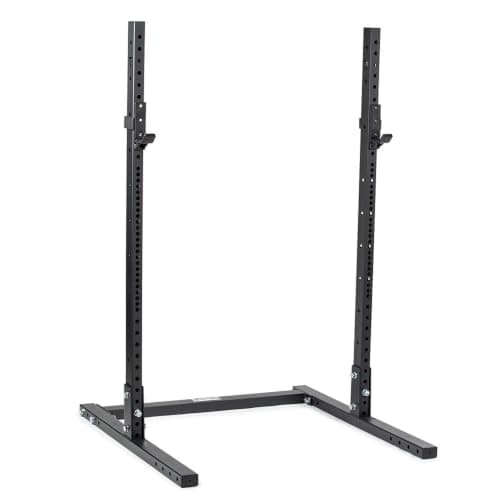
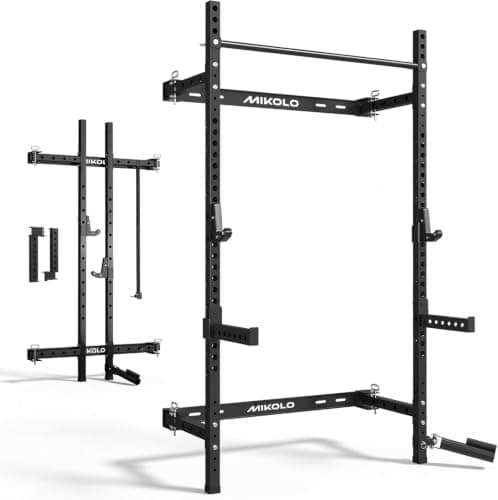
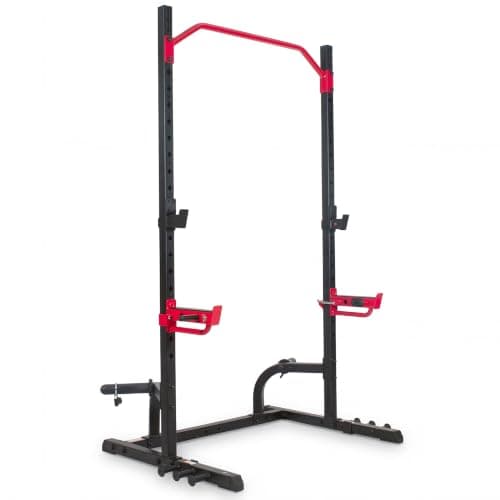
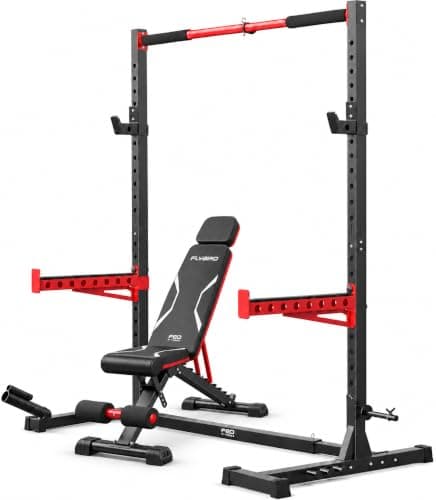
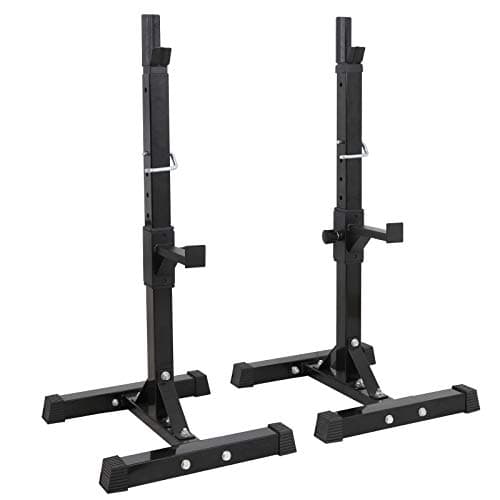
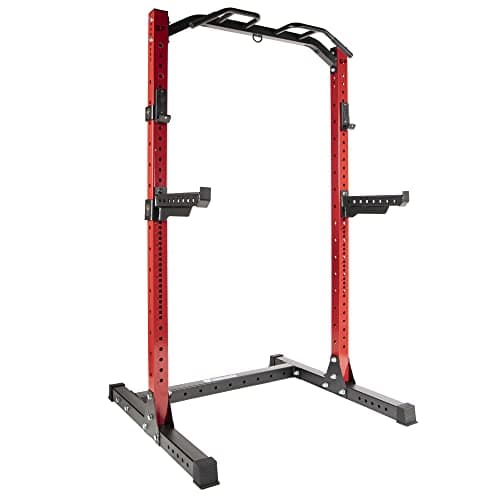
The best squat rack under $500 is the Signature Fitness SF-SS1, because it is the only frame inside the ceiling that publishes a 3 x 3 inch upright and ships the safeties with it. It is for the lifter who wants the uprights to be the last uprights. The budget pick is the F2C pair of adjustable posts, which costs a fraction of the ceiling and is honest about being the lightest-duty thing on the page. Between those two sits the decision this page exists to make: at this price you are choosing between heavier tubing and more stations, and almost every listing in the category is built to make you choose stations.
Five hundred dollars is a real line in this category rather than an arbitrary one. Below about $200 every option is a pair of posts or a light stand, and the honest comparison is the budget squat rack roundup. Above about $700 you are into full enclosed cages, which is a different shape of purchase entirely and is covered on the racks under $1,000 page. The $500 band is where the steel genuinely changes — it is the first ceiling that reaches a commercial-size upright — and it is where most home gyms actually shop.
How we ranked these
Four things decide whether a squat rack is still standing and still tight in a decade, and none of them is the number of accessories in the box.
1. Upright size first, then gauge, then the rating
A 3 x 3 inch upright is stiffer than a 2 x 2 inch upright of the same wall thickness, and it buys you into the hole-pattern ecosystem most aftermarket J-cups and safeties are built around. Only one rack in this band publishes a 3 x 3 upright and only one publishes a gauge figure at all — the Titan, at 11 gauge — and both of those facts matter more than a headline capacity number. The reason tube size beats the rating is worked through in 2 x 2 vs 3 x 3 power racks, and gauge has its own reference page at power rack steel gauge.
2. Whether a failed rep has somewhere to land
This is the spec that separates a rack from a pair of posts, and it is the one most listings bury. Two picks here arrive with safety catches or spotter arms included; two can take them as an add-on; one has nowhere to put them at all. If you train alone — and most home gym owners do — this is not a nice-to-have. We rank it above footprint and above the accessory count, and the strap-versus-steel version of the question is covered in safety bars vs safety straps.
3. Whether anyone will sell you a part in year eight
A J-cup liner wears. A pop-pin bends. A plastic upright cap goes missing and the tube starts collecting water. On a rack from a brand with a catalog and a parts process, each of those is a small order; on a rack from a marketplace label that will not exist in three years, each is the end of the rack. Titan, Sunny and Signature all have a route to a replacement part here, and that is a large part of why they finish where they do. The general case is in replacement parts for home gym equipment.
4. Footprint, measured honestly
A two-post stand needs its own floor and a working envelope around it. A folding wall rack needs structural studs and gives the floor back between sessions. A short stand solves a headroom problem and creates a pull-up problem. None of these is better in the abstract — they are answers to different rooms, and the best squat racks for small spaces is the page that turns a tight room into a shortlist.
What $500 actually buys, and what it does not
It buys a 3 x 3 inch upright with a 1,000 lb rating and spotter arms in the box. It buys 11-gauge steel with published upright and overall heights, from a brand that will sell you hardware in a decade. It buys a 1,000 lb folding frame that disappears against a wall. What it does not buy is all of those at once, and any listing suggesting otherwise is counting stations rather than specifying steel.
It also does not buy an enclosed cage. Every pick on this page is an open frame or a pair of posts, which means a failed rep is caught by spotter arms if you have them and dumped on the floor if you do not. That is the structural trade of this whole category, and it is the reason the power rack vs squat rack comparison exists. If you train heavy singles alone, read that page before you spend anything here.
And it does not buy a lifetime frame warranty. The brands that warranty a rack frame for life sit well above this ceiling. What you can get inside $500 is a published capacity, a documented parts route and tubing heavy enough that the warranty rarely comes up — which, for a home gym that sees four sessions a week, is most of the way there. The market-wide picture is in lifetime warranties on home gym equipment.
Steel versus stations: the actual decision
Here is the clearest way to put it. The Signature publishes a 3 x 3 upright and a 1,000 lb rating and gives you no pull-up bar. The FLYBIRD and the Sunny both give you a pull-up bar and publish no capacity figure at all. Read naively, the racks with the bar win on features. Read properly, those are not the same measurement: an upright dimension tells you how much the posts deflect when you rack a heavy bar, and a pull-up bar tells you that someone welded a tube across the top.
So the question is which compromise you would rather live with. If your program is squat, bench, press and rack pulls, the heavier two-post stand is the better buy and a doorway or wall-mounted bar covers the pulling work for very little — the options are ranked on the best pull-up bars page. If you want overhead pulling inside the same footprint and you are not loading near the rating, the full-size open frame genuinely is the more complete gym, and the dedicated comparison is the best squat racks with pull-up bars.
The folding pick is a third answer. It gives you a 1,000 lb rating, safety catches, a pull-up bar and a landmine in one box, and then asks for your wall. That is an excellent trade in a single-car garage and a non-starter on drywall over metal studs. The rest of that category is compared on the folding rack roundup.
The anchoring question, which this band makes unavoidable
An enclosed cage has four posts and a wide base, so it resists tipping on its own mass. Nothing on this page does. A two-post stand under a loaded bar is a tall object with a narrow base, and the fix is one of three things: bolt the feet down, load the plate posts if the frame has them, or accept a lower working weight. The folding rack does not get a choice — it bolts into the wall or it does not go up at all.
This is not a defect of cheap racks; it is geometry, and it is the most common thing buyers in this band get wrong. The full version, including what to use on a concrete slab and what to do on a wood subfloor, is in how to anchor a squat rack and do you need to bolt down a power rack.
Who each pick is for
Signature SF-SS1 — you want the heaviest upright $500 reaches, you want the safeties included, and you may want to convert it to a full rack later. Titan T-3 Short stand — you have a basement or a low garage and you want published numbers you can check against a tape measure first; it is also the pick on the best racks for a low ceiling. Mikolo folding rack — you have a solid wall and the floor has to be floor again on Saturday. Sunny full-size rack — you want real pull-up bar height and an attachment line you can still order from in a few years. FLYBIRD SR1 — you want the smallest sensible adjustable frame with a bar on top, and the full review is here. F2C posts — the ceiling is under about 6 ft 6 in, or you need to carry the rack out of the way, and you accept there is nothing to bail onto.
Two cheap additions change what any of these frames can do. Steel spotter arms turn an open stand into something you can fail in — ranked on the best spotter arms page — and a landmine pivot adds a whole category of rows and presses for the price of a takeaway, compared on the best landmine attachments page. A rack is also only half a bench press; the best benches for a power rack is the other half.